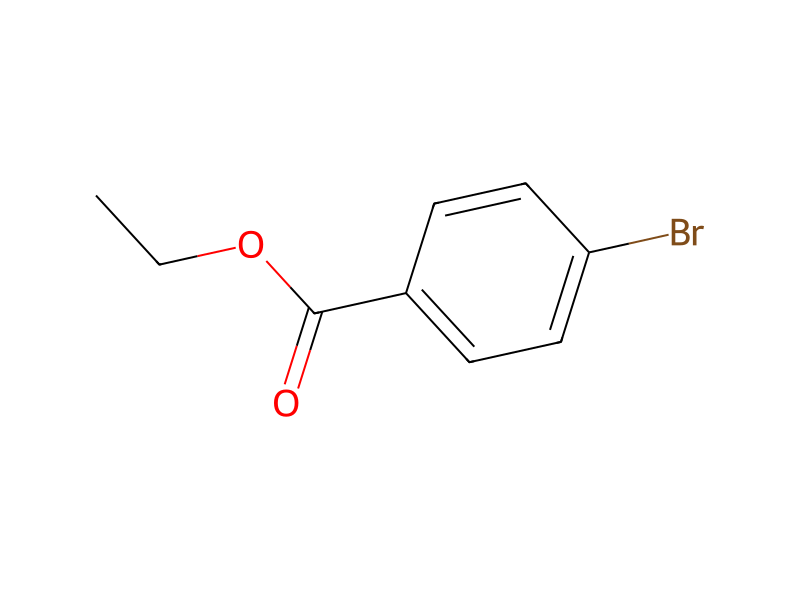
Ethyl 4-bromobenzoate → HCID 15661142, compound
Reaction equation

[CH3:1][C:2]1([CH3:14])[C:11]2[C:6](=[CH:7][CH:8]=[C:9]([C:12]#[CH:13])[CH:10]=2)[O:5][CH2:4][CH2:3]1.C([Li])CCC.Br[C:21]1[CH:31]=[CH:30][C:24]([C:25]([O:27][CH2:28][CH3:29])=[O:26])=[CH:23][CH:22]=1>O1CCCC1.CCCCCC>[CH3:1][C:2]1([CH3:14])[C:11]2[C:6](=[CH:7][CH:8]=[C:9]([C:12]#[C:13][C:21]3[CH:31]=[CH:30][C:24]([C:25]([O:27][CH2:28][CH3:29])=[O:26])=[CH:23][CH:22]=3)[CH:10]=2)[O:5][CH2:4][CH2:3]1Participants
Reactant 3


Product 1

Reagents, catalysts & solvents 2


Conditions
- Temperature
- 0 °C
Procedure
Reaction vessels used in this procedure were flame dried under vacuum and all operations were carried out in an oxygen-free, argon or nitrogen atmosphere. To a solution of 509.4 mg (2.74 mmol) of 4,4-dimethyl-6-ethynyl chroman (from Example 10) in 4 ml of dry tetrahydrofuran at 0° C. was added dropwise 1.72 ml of 1.6M (2.75 mmol) of n-butyl lithium in hexane. Stirring was commenced at 0° C. for 30 minutes and at room temperature for 15 minutes, after which the solution was cooled again to 0° C. and then treated with a solution of 380 mg (2.79 mmol) of fused zinc chloride in 5 ml of dry tetrahydrofuran using a double ended needle. The resulting solution was stirred at 0° C. for 1 hour and then at room temperature for 15 minutes. A solution of 628.6 mg (2.74 mmol) of ethyl 4-bromobenzoate in 4 ml of dry tetrahydrofuran was transferred by double ended needle into a suspension of 380 mg (0.33 mmol) of tetrakistriphenylphosphine palladium in 5 ml dry tetrahydrofuran and stirred at room temperature for 15 minutes, then treated by double ended needle with the solution of alkynyl zinc chloride prepared above. The mixture was stirred at room temperature for 20 hours and then quenched with ice and 30 ml of 3N hydrogen chloride. The mixture was then extracted with 3×75 ml ether and ether extracts were combined and washed successively with saturated NaHCO3 and saturated NaCl solutions and then dried (MgSO4). Solvent was removed in vacuo and the residue further purified by flash chromatography (silica; 10% ethyl acetate in hexane) to obtain the captioned compound as a white solid. PMR (CDCl3): δ 1.36 (6H), 1.42 (3H, t, J~7.3 Hz), 1.82-1.86 (2H, m), 4.21-4.25 (2H, m), 4.40 (2H, q, J~7.3 Hz), 6.79 (1H, d, J~8.1 Hz), 7.28 (1H, dd, J~8.1 Hz, 2.2 Hz), 7.50 (1H, d, J~2.2 Hz), 7.58 (2H, d, J~8.7 Hz), 8.03 (2H, d, J~8.7 Hz).
Workup
- customReaction vessels
- temperaturewere flame
- customdried under vacuum
- stirringThe resulting solution was stirred at 0° C. for 1 hour
- waitat room temperature for 15 minutes
- stirringstirred at room temperature for 15 minutes
- customprepared above
- stirringThe mixture was stirred at room temperature for 20 hours
- customquenched with ice and 30 ml of 3N hydrogen chloride
- extractionThe mixture was then extracted with 3×75 ml ether and ether extracts
- washwashed successively with saturated NaHCO3 and saturated NaCl solutions
- dry with materialdried (MgSO4)
- customSolvent was removed in vacuo
- customthe residue further purified by flash chromatography (silica; 10% ethyl acetate in hexane)
Sources & evidence
- ORD record
- ord-90004df52a26434e8e59b89a7c48142b
- Source dataset
- uspto-grants-1989_03
- Patent number
- US04810804
Reaction notes
Loading…