Ammonia → Phthalonitrile
Reaction equation

[C:1]1([CH3:9])[C:2]([C:7]#[N:8])=[CH:3][CH:4]=[CH:5][CH:6]=1.[NH3:10].O=O>>[CH:4]1[CH:3]=[C:2]([C:7]#[N:8])[C:1]([C:9]#[N:10])=[CH:6][CH:5]=1Participants



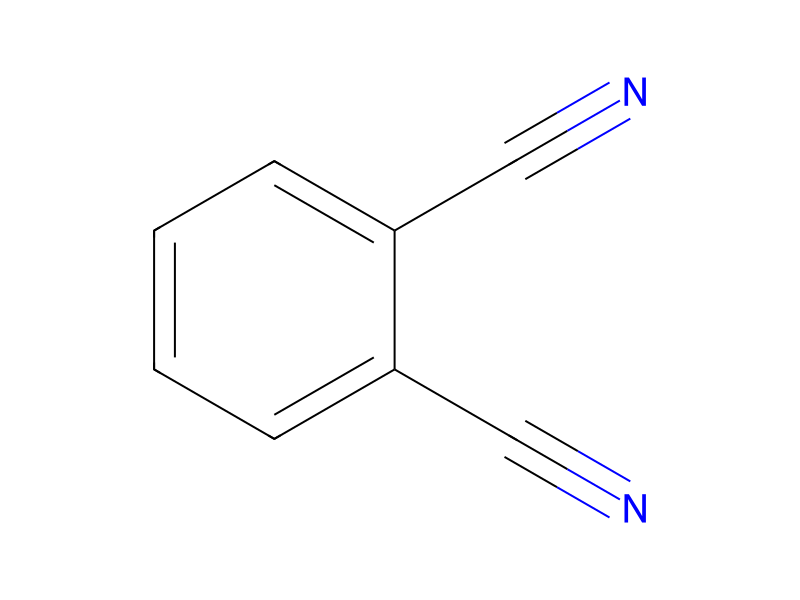
Procedure
750 ml of a catalyst having a particle size of from 0.05 to 0.3 mm are introduced into a quartz reactor which has a diameter of 60 mm and a length of 1000 mm and is provided with an external heater and a quartz frit for uniformly distributing the reaction gas. The catalyst is composed of 5.0% by weight of V2O5, 5.9% by weight of Sb2O3 0.24% by weight of K2O, 0.56% by weight of BaO and 88.3% by weight of γ-Al2O3. The reactor is heated to 470° C. and a gas mixture consisting of 3.25% by volume of o-xylene, 13% by volume of oxygen and 83.75% by volume of ammonia is passed through. The hot reaction gases are cooled to 70° C. with ammonia water in two wash towers arranged in series. An aqueous suspension of crystals is formed, from which the o-phthalodinitrile is isolated by filtration. 2,687 parts of o-xylene give 2,581 parts of o-phthalodinitrile and 195 parts of o-tolunitrile. By reacting the 195 parts of o-tolunitrile again with ammonia and oxygen, a further 170 parts of o-phthalodinitrile are obtained. The total yield of o-phthalodinitrile is 84.8 mol %, based on converted o-xylene.
Sources & evidence
- ORD record
- ord-541941d70fb243ae8055ed887a7d3cac
- Source dataset
- uspto-grants-1989_03
- Patent number
- US04814479
Reaction notes
Loading…