Isopropanol → HCID 135964999, compound
Reaction equation

[OH:1][C:2]1[CH:3]=[C:4]([CH:7]=[C:8]([N+:11]([O-:13])=[O:12])[C:9]=1[OH:10])[CH:5]=O.[N:14]1[CH:19]=[CH:18][C:17]([CH3:20])=[CH:16][CH:15]=1.C(O)(C)C>C(OC(=O)C)(=O)C>[N+:11]([C:8]1[CH:7]=[C:4]([CH:5]=[CH:20][C:17]2[CH:18]=[CH:19][N:14]=[CH:15][CH:16]=2)[CH:3]=[C:2]([OH:1])[C:9]=1[OH:10])([O-:13])=[O:12]Participants
5
Reactant 3


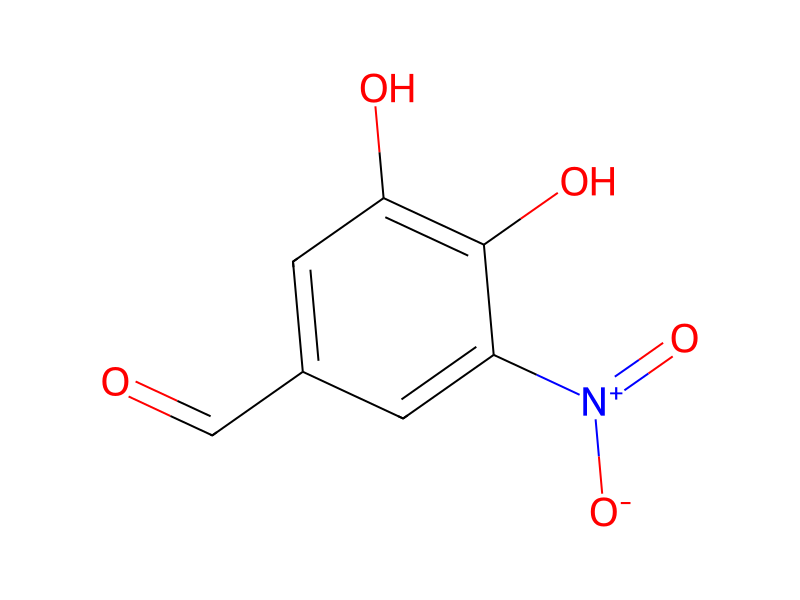
Product 1

Reagents, catalysts & solvents 1

Procedure
A solution containing 2.0 g (0.011 mole) of 3,4-dihydroxy5-nitrobenzaldehyde and 2.23 g (0.024 mole) of 4-picoline in 9.0 ml of acetic anhydride was refluxed for 1 h. About 15 ml of isopropanol was then added and the solution was cooled to 0° C. where upon the diacetyl-derivative of the desired product crystallized. After filtration the product was suspended in 100 ml of 0.5 N hydrochloric acid and refluxed for 1.5 h. After cooling the precipitate was filtered, washed with water and acetone and dried. Yield 1.89 g (67%), m.p. above 350° C.
Workup
- temperaturewas refluxed for 1 h
Sources & evidence
- ORD record
- ord-311a5aacc3a14415bd07d60b094ca9f6
- Source dataset
- uspto-grants-1992_05
- Patent number
- US05112861
Reaction notes
Loading…