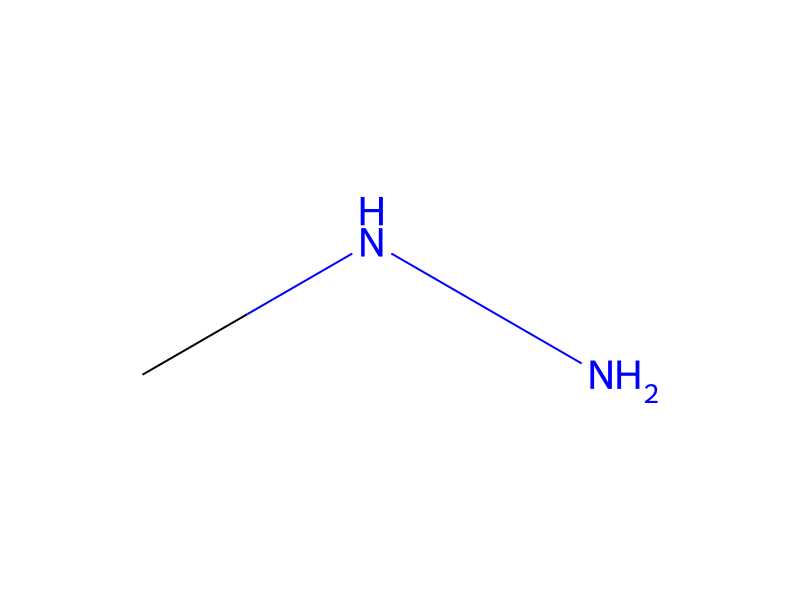
Methylhydrazine → 1-benzyl-1-methylhydrazine
Reaction equation

[CH3:1][NH:2][NH2:3].[CH2:4](Br)[C:5]1[CH:10]=[CH:9][CH:8]=[CH:7][CH:6]=1>ClCCl>[CH2:4]([N:2]([CH3:1])[NH2:3])[C:5]1[CH:10]=[CH:9][CH:8]=[CH:7][CH:6]=1Participants
4
Reactant 2

Product 1

Reagents, catalysts & solvents 1

Procedure
Methylhydrazine (0.1 ml, 2.0 mmol) in dichloromethane (5 ml) was treated dropwise with a solution of benzyl bromide (0.12 ml, 1.0 mmol) in dichloromethane (2 ml). After addition was complete the mixture was stirred for 10 min. and evaporated to dryness under reduced pressure. The residue was diluted with brine (5 ml) and ethyl acetate (5 ml). The organic phase was separated, dried over magnesium sulphate and evaporated to dryness under reduced pressure to give N-benzyl-N-methylhydrazine (0.082 g, 60%); υmax (CH2Cl2) 1650 cm-1 ; δH (CDCl3) 2.49 (3H, s), 3.41 (2H, s), 3.60 (2H, s), and 7.27 (5H, s).
Workup
- additionAfter addition
- customevaporated to dryness under reduced pressure
- additionThe residue was diluted with brine (5 ml) and ethyl acetate (5 ml)
- customThe organic phase was separated
- dry with materialdried over magnesium sulphate
- customevaporated to dryness under reduced pressure
Sources & evidence
- ORD record
- ord-b2e0845dc82f4cd998a8ecb725d54cbd
- Source dataset
- uspto-grants-1994_01
- Patent number
- US05275816
Reaction notes
Loading…