Sulfuric Acid → p-Toluenesulfonic acid
Reaction equation

OCC([C@H]([C@@H]([C@@H](CO)O)O)O)=O.OCC1(O[C@H](CO)[C@@H](O)[C@@H]1O)OC.[S:26](=[O:30])(=O)([OH:28])[OH:27].CO[CH:33](OC)[C:34]1[CH:39]=[CH:38][CH:37]=[CH:36][CH:35]=1>CO>[C:34]1([CH3:33])[CH:39]=[CH:38][C:37]([S:26]([OH:28])(=[O:30])=[O:27])=[CH:36][CH:35]=1Participants
Reactant 4

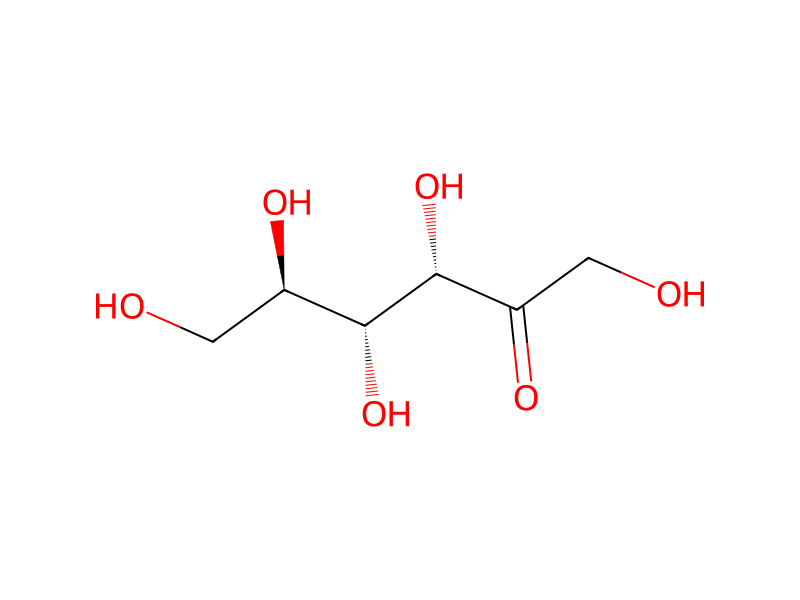


Product 1

Reagents, catalysts & solvents 1

Procedure
In step one, fructose is converted to methyl fructofuranoside by reaction in methanol using sulfuric acid as the catalyst; this reaction yields an anomeric mixture of methyl α,β-fructofuranosides. In step two, the 1- and 3-hydroxyl groups of the product of step one are protected by conversion to a benzylidene derivative. For example, reaction of the described anomeric mixture of methyl α,β-fructofuransides with benzaldehyde dimethylacetal and a proton source such as p-toluenesulfonic acid, yields methyl 1,3-O-benzylidene-α-D-fructofuranoside. In step three, the 6-hydroxy group of the product of step two is protected by conversion to a trialkylsilyl ether. For example, reaction of 1,3-O-benzylidene-α-D-fructofuranoside with t-butyldimethylsilyl chloride and imidazole yields the t-butyldimethylsilyl ether derivative methyl 1,3-O-benzylidene-6-O-t-butyldimethylsilyl-α-D-fructofuranoside. In step four, the 4-hydroxy group of the product of step three is replaced with a hydrogen atom. For example, reaction of 1,3-O-benzylidene-6-O-t-butyldimethylsilyl-α-D-fructofuranoside with thiocarbonyldiimidazole affords an intermediate which is then reacted with tri-n-butyl tin hydride and azo(bis)isobutyronitrile (AIBN) to yield the deoxy derivative, methyl 1,3-O-benzylidene-6-O-t-butyl-dimethylsilyl-4-deoxy-α-D-fructofuranoside. In step five, the trialkylsilyl group is removed from the 6-O-trialkysilyl ether of the product of step four, and the resulting 6-hydroxy group is esterified. For example, reaction of methyl 1,3-O-benzylidene-6-O-t-butyl-dimethylsilyl-4-deoxy-α-D-fructofuranoside with tetrabutylammonium fluoride affords the 6-hydroxy derivative, methyl 1,3-O-benzylidene-4-deoxy-α-D-fructofuranoside which is then reacted with benzoyl chloride to give the O-ester derivative, methyl 6-O-benzoyl-1,3-O-benzylidene-4-deoxy-α-D-fructofuranoside. Compounds of Formula II, which serve as intermediates to compounds of Formula I (when A is H), are produced in step six in which the 1,3-O-benzylidene group is removed giving a derivative with 1,3-dihydroxy groups. For example, reaction of 6-O-benzoyl-1,3-O-benzylidene-4-deoxy-α-D-fructofuranoside in an acidic medium such as an alcohol containing p-toluenesulfonic acid yields the methyl 6-O-benzoyl-4-deoxy-α,β-D-fructofuranoside. The α anomer, methyl 6-O-benzoyl-4-deoxy-α-D-fructofuranoside, and β anomer, methyl 6-O-benzoyl-4-deoxy-β-D-fructofuranoside, of the anomeric mixture obtained in step six may then be separated from each other and isolated in anomerically pure form by chromatography.
Workup
- customthis reaction yields
Sources & evidence
- ORD record
- ord-f025178968574630956966f21b382d3e
- Source dataset
- uspto-grants-1994_01
- Patent number
- US05276143
Reaction notes
Loading…