3-Bromobenzonitrile → HCID 19102561, compound
Reaction equation

C([Li])CCC.Br[C:7]1[CH:8]=[C:9]([CH:12]=[CH:13][CH:14]=1)[C:10]#[N:11].[N:15]1[C:24]2[C:19](=[CH:20][CH:21]=[CH:22][CH:23]=2)[CH:18]=[CH:17][C:16]=1/[CH:25]=[CH:26]/[C:27]1[CH:28]=[C:29]([CH:32]=[CH:33][CH:34]=1)[CH:30]=[O:31].[Cl-].[NH4+]>CCCCCC.O1CCCC1.CCOCC>[OH:31][CH:30]([C:7]1[CH:8]=[C:9]([CH:12]=[CH:13][CH:14]=1)[C:10]#[N:11])[C:29]1[CH:32]=[CH:33][CH:34]=[C:27](/[CH:26]=[CH:25]/[C:16]2[CH:17]=[CH:18][C:19]3[C:24](=[CH:23][CH:22]=[CH:21][CH:20]=3)[N:15]=2)[CH:28]=1Participants
8
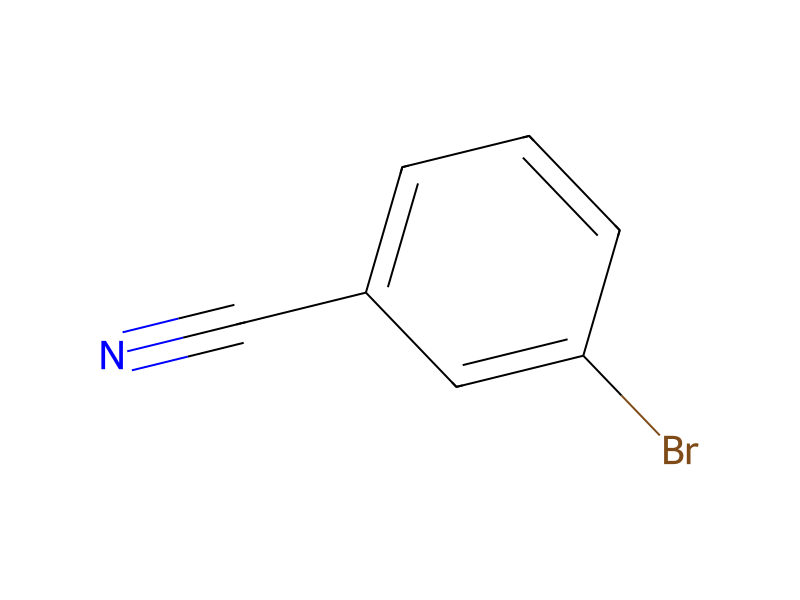







Conditions
- Temperature
- -100 °C
Procedure
2.5M n-Butyl lithium solution in hexane (2.6 ml) was added dropwise to a stirred solution of 3-bromobenzonitrile (1.2 g, 6.56 mmol) in tetrahydrofuran (20 ml) and ether (20 ml) at -100° to -110° C. under nitrogen. The yellow solution was stirred at -100° C. for 5 minutes, then a solution of 3-[2(E)-(quinolin-2-yl)ethenyl]benzaldehyde (1.7 g, 6.56 mmol) in tetrahydrofuran (7 ml) was added. The dark brown solution was allowed to warm to room temperature, poured onto saturated ammonium chloride solution and extracted with ethyl acetate. The extract was dried and evaporated and the residue was chromatographed on silica in ethyl acetate-hexane (1:2) to give a pale yellow solid.
Workup
- temperatureto warm to room temperature
- extractionextracted with ethyl acetate
- customThe extract was dried
- customevaporated
- customthe residue was chromatographed on silica in ethyl acetate-hexane (1:2)
- customto give a pale yellow solid
Sources & evidence
- ORD record
- ord-f69f63cca7494800852d6c5dbf79cecd
- Source dataset
- uspto-grants-1994_01
- Patent number
- US05281593
Reaction notes
Loading…