Silica → Sodium sulfate decahydrate
Reaction equation

[S:1]([O-:5])([O-:4])(=[O:3])=[O:2].[Na+:6].[Na+].[O:8]=[Si]=O>O>[OH2:2].[OH2:8].[OH2:2].[OH2:2].[OH2:2].[OH2:2].[OH2:2].[OH2:2].[OH2:2].[OH2:2].[S:1]([O-:5])([O-:4])(=[O:3])=[O:2].[Na+:6].[Na+:6]Participants
Reagents, catalysts & solvents 1

Procedure
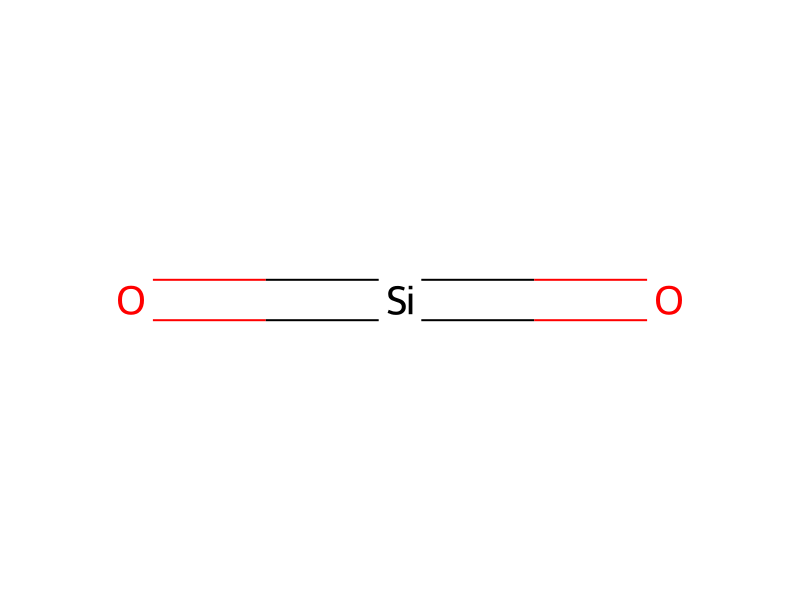
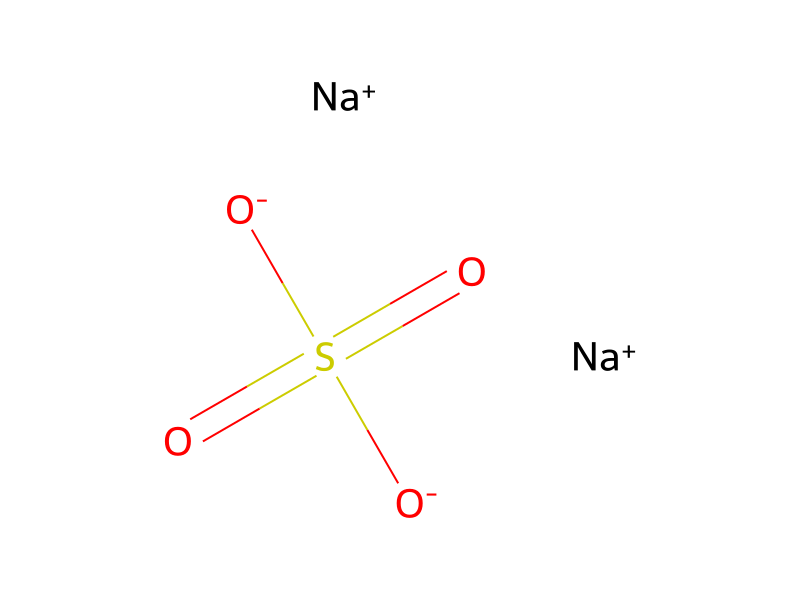
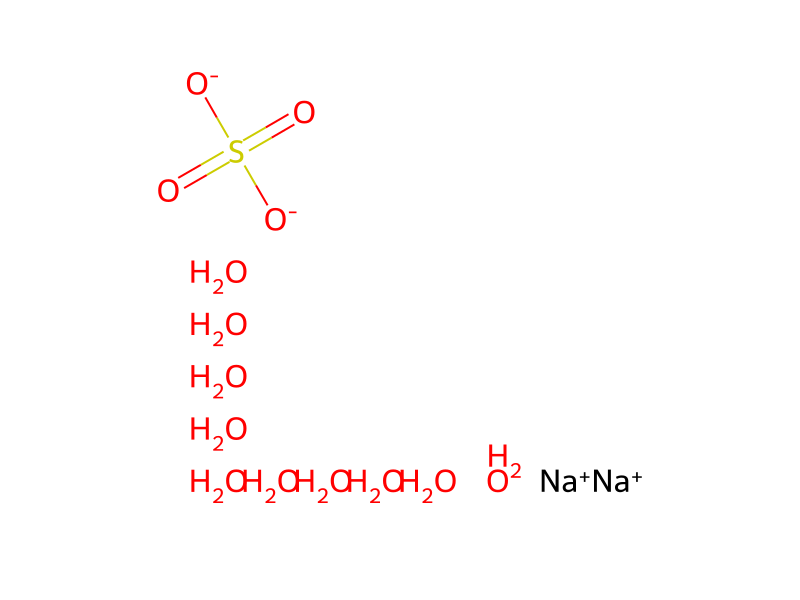
As illustrated in FIG. 5, the improved composition is presently formed by first mixing 200 lbs. of anhydrous sodium sulfate with 60 gallons of water and agitation to create an aqueous solution which is approximately 26% by weight, sodium sulfate. The water is preheated to 120° to 150° F., and normally 145° F. After the saturated solution-slurry has been formed, 16 pounds of a hydrophilic suspension agent such as CAB-O-SIL, by Cabot Corporation (fumed silicon dioxide) is then added to the solution with a gentle, low shear agitation, such as that imparted by a jet mixer, to achieve a total weight of 1.5 to 2.5% in the final composition. After the CAB-O-SIL has been evenly dispersed, an additional 340 lbs., or 20 to 25% by weight of anhydrous sodium sulfate is added with agitation at 120° to 140° F. to form a slurry that is approximately 51% by weight of sodium sulfate. This slurry may then be cast into any desired form, and then cooled below 90° to form sodium sulfate decahydrate, with evenly dispersed finely divided crystalline anhydrous sodium sulfate particles therein. Nucleation agents are no longer necessary. The resulting composition is a hard white crystalline block of decahydrate salt and sodium sulfate crystals interlinked together by hydrogen bonding with the long chain fumed silicon dioxide hydroxyl groups The improved composition also results in a superior performance, having approximately twice the heat absorption characteristics of the prior art "salt foam." It is estimated that the latent heat of the improved composition is approximately 83 BTU per pound (46 cal/g).
Workup
- customthe improved composition is presently formed
- additionby first mixing 200 lbs
- customis preheated to 120° to 150° F.
- customnormally 145° F
- customAfter the saturated solution-slurry has been formed
- customto form a slurry that
- temperaturecooled below 90°
Sources & evidence
- ORD record
- ord-36797a449d254cc3a00021c7d911f7a4
- Source dataset
- uspto-grants-1990_02
- Patent number
- US04903493
Reaction notes
Loading…