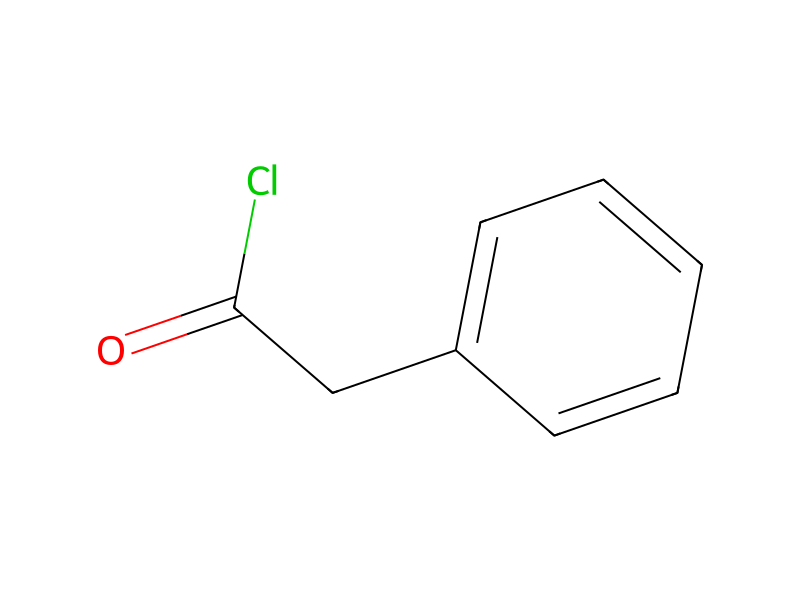
Phenylacetyl chloride → HCID 21939585, compound
Reaction equation

[C:1]([N:8]1[CH2:13][CH2:12][NH:11][CH2:10][CH2:9]1)([O:3][C:4]([CH3:7])([CH3:6])[CH3:5])=[O:2].C([N:17](C(C)C)CC)(C)C.[C:23]1([CH2:29][C:30](Cl)=[O:31])[CH:28]=[CH:27][CH:26]=[CH:25][CH:24]=1>ClCCl>[C:1]([N:8]1[CH2:9][CH2:10][N:11]([NH:17][C:30](=[O:31])[CH2:29][C:23]2[CH:28]=[CH:27][CH:26]=[CH:25][CH:24]=2)[CH2:12][CH2:13]1)([O:3][C:4]([CH3:7])([CH3:6])[CH3:5])=[O:2]Participants
Reactant 3


Product 1

Reagents, catalysts & solvents 1

Procedure
BOC-Piperazine (1.06 g) was combined with dichloromethane (20.0 mL) and diisopropylethylamine (1.49 mL). Phenylacetylchloride (0.90 mL) was added dropwise and the reaction was allowed to stir at room temperature for 24 hours. The reaction was then washed with HCl (1N in water, 3×5 mL), saturated aqueous sodium bicarbonate (3×5 mL) and brine (5 mL). The organic layer was dried over anhydrous magnesium sulfate, filtered and concentrated giving 1-BOC-4-phenylacetamidopiperazine (1.73 g). Yield=100% Step 2: The BOC group was removed from 1-BOC-4-phenylacetamidopiperazine according to example 137 giving phenylacetamidopiperazine hydrochloride. Yield=93%. Step 3: Phenylacetamidopiperazine hydrochloride was reacted with 8-ethyl-6-chloropurine (Example 140) according to Example 87. Yield=27%, ES-MS: (M+H)+ 351.
Workup
- washThe reaction was then washed with HCl (1N in water, 3×5 mL), saturated aqueous sodium bicarbonate (3×5 mL) and brine (5 mL)
- dry with materialThe organic layer was dried over anhydrous magnesium sulfate
- filtrationfiltered
- concentrationconcentrated
Sources & evidence
- ORD record
- ord-cb6d587a2c7d4577a0f3b334d7929e8c
- Source dataset
- uspto-grants-2006_10
- Patent number
- US07115741B2
Reaction notes
Loading…