Triethylborane → HCID 21928368, compound
Reaction equation

[Cl:1][C:2]1[C:7]([C:8]#[N:9])=[CH:6][C:5]([F:10])=[C:4](Cl)[N:3]=1.P([O-])([O-])([O-])=O.[K+].[K+].[K+].[CH2:20](B(CC)CC)[CH3:21]>C1COCC1.C1C=CC(P(C2C=CC=CC=2)[C-]2C=CC=C2)=CC=1.C1C=CC(P(C2C=CC=CC=2)[C-]2C=CC=C2)=CC=1.Cl[Pd]Cl.[Fe+2]>[Cl:1][C:2]1[C:7]([C:8]#[N:9])=[CH:6][C:5]([F:10])=[C:4]([CH2:20][CH3:21])[N:3]=1Participants
6
Reactant 3
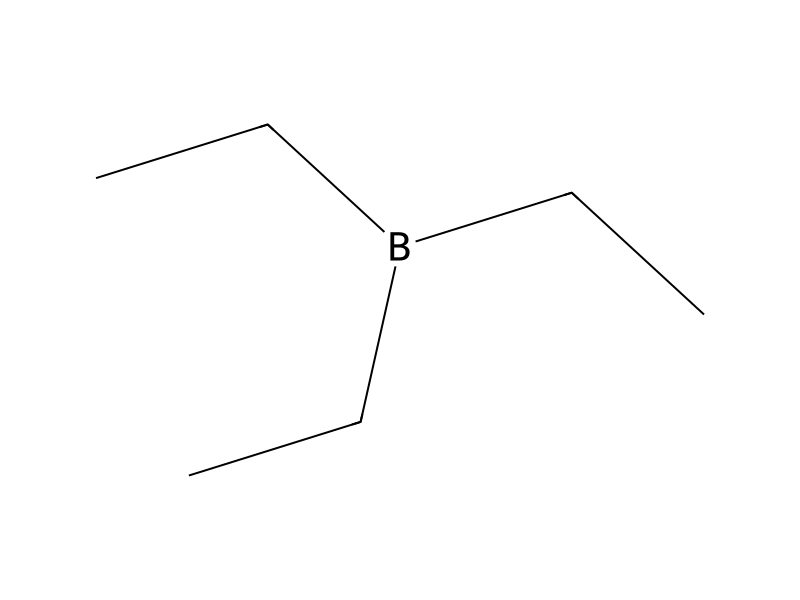


Product 1

Reagents, catalysts & solvents 2


Procedure
To a vigorously stirred mixture of 2,6-dichloro-5-fluoro-3-pyridinecarbonitrile (15.0 g, 78.5 mmol), potassium phosphate (17.0 g, 74.0 mmol), and [1,1′-bis(diphenylphosphino)ferrocene]dichloropalladium(II) (1.5 g, 1.8 mmol) in dry THF (300 ml) at room temperature was added in a stream triethylborane (85 ml of a 1M solution in THF). The resulting mixture was heated at reflux temperature for 16 h, cooled, concentrated, and partitioned between ethyl acetate and water. The resulting crude product obtained from the organics was subjected to flash chromatography using ethyl acetate/hexanes as eluent to give the title compound (8 g) as a solid.
Workup
- temperatureThe resulting mixture was heated
- temperatureat reflux temperature for 16 h
- temperaturecooled
- concentrationconcentrated
- custompartitioned between ethyl acetate and water
- customThe resulting crude product obtained from the
Sources & evidence
- ORD record
- ord-ab2f9b1f57e6444f915bce04d8ece7d8
- Source dataset
- uspto-grants-2006_10
- Patent number
- US07119109B2
Reaction notes
Loading…