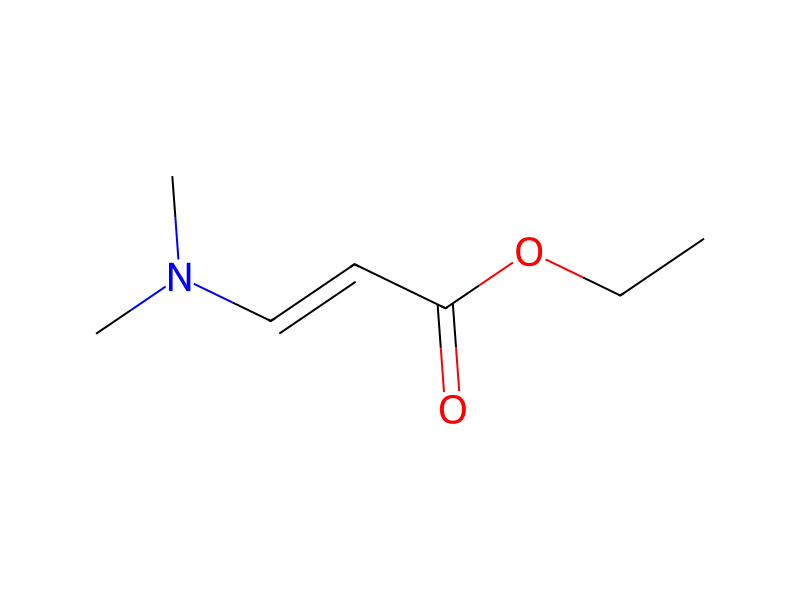
Ethyl 3-(N,N-dimethylamino)acrylate → HCID 69594764, compound
Reaction equation

Cl.[O:2]=[C:3]1[CH:8]=[CH:7][C:6]([C:15]2[CH:20]=[CH:19][CH:18]=[CH:17][CH:16]=2)([C:9]2[CH:14]=[CH:13][CH:12]=[CH:11][CH:10]=2)[CH2:5][CH:4]1[NH2:21].CN(C)[CH:24]=[CH:25][C:26]([O:28][CH2:29][CH3:30])=[O:27]>CO>[O:2]=[C:3]1[CH:8]=[CH:7][C:6]([C:9]2[CH:14]=[CH:13][CH:12]=[CH:11][CH:10]=2)([C:15]2[CH:20]=[CH:19][CH:18]=[CH:17][CH:16]=2)[CH2:5][CH:4]1[NH:21][CH:24]=[CH:25][C:26]([O:28][CH2:29][CH3:30])=[O:27]Participants
4
Reactant 2

Product 1

Reagents, catalysts & solvents 1

Conditions
- Temperature
- 0 °C
Procedure
0.27 g of 2-oxo-5,5-diphenylcyclohex-3-enylamine hydrochloride is dissolved in 3 cm3 of methanol and the solution is cooled to a temperature in the region of 0° C. 0.14 cm3 of ethyl 3-dimethylaminoacrylate is added to the preceding solution and the mixture is stirred for about 60 hours at a temperature in the region of 20° C. The reaction mixture is then concentrated to dryness under reduced pressure (13 kPa) and the residue is taken up in 12 cm3 of tetrahydrofuran. 0.3 g of ethyl 3-(2-oxo-5,5-diphenylcyclohex-3-enylamino)acrylate is obtained in the form of an orange-coloured oil, which is used without further modification in subsequent syntheses and the characteristics of which are as follows:
Workup
- concentrationThe reaction mixture is then concentrated to dryness under reduced pressure (13 kPa)
Sources & evidence
- ORD record
- ord-d748d70cd9be41a8bcbdd529b2836b95
- Source dataset
- uspto-grants-2006_10
- Patent number
- US07119115B2
Reaction notes
Loading…