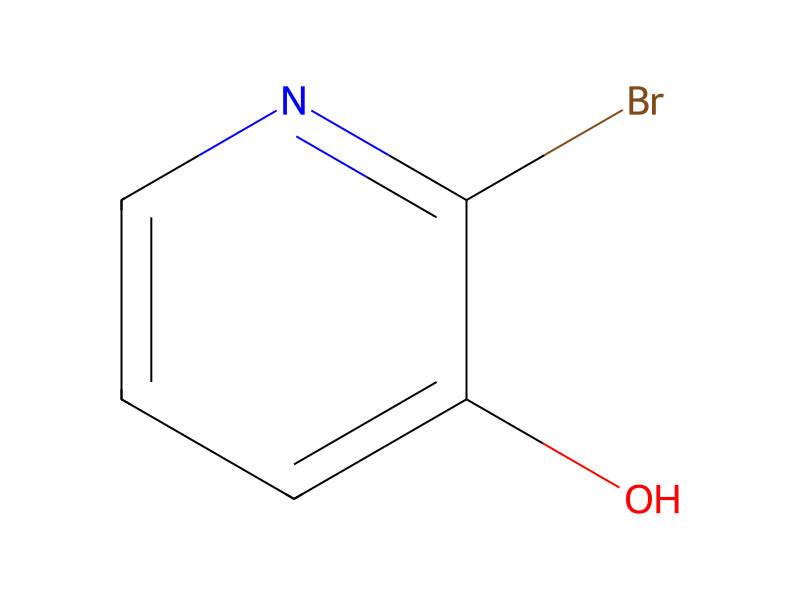
2-Bromo-3-pyridinol → 2-Phenyl-3-pyridinol
Reaction equation

Br[C:2]1[C:7]([OH:8])=[CH:6][CH:5]=[CH:4][N:3]=1.[C:9]1(B(O)O)[CH:14]=[CH:13][CH:12]=[CH:11][CH:10]=1>C1C=CC=CC=1.C(=O)([O-])[O-].[Na+].[Na+]>[C:9]1([C:2]2[C:7]([OH:8])=[CH:6][CH:5]=[CH:4][N:3]=2)[CH:14]=[CH:13][CH:12]=[CH:11][CH:10]=1Participants
Reactant 2

Product 1

Reagents, catalysts & solvents 2


Procedure
To a 1 liter round bottom flask equipped with a nitrogen inlet and a condenser was introduced 25 gm. (143.68 mmol) 2-bromo-3-hydroxypyridine, 19.27 gm. (156 mmol) phenylboronic acid, 5 gm (4.31 mmol) tetrakistriphenylphosphine palladium (0). The contents were dissolved in 300 ml of benzene and 100 ml of 2M aqueous sodium carbonate solution. The reaction mixture was heated under reflux for a period of 18 hours. The mixture was allowed to cool to room temperature and extracted with ethyl acetate (4×100 ml). The organic phase was dried over sodium sulfate and concentrated in vacuo. The residue was taken up in chloroform followed by treatment with ether to afford a solid precipitate. Upon filtration there was obtained 10.4 gm (42%) of 2-phenyl-3-hydroxypyridine. 1H NMR (CDCl3, 400 MHz) δ 8.22 (d, 1H), 7.71 (d, 2H), 7.51–7.40 (m, 2H), 7.22 (d, 2H), 7.15 (m, 1H) ppm. Mass spectrum APCI m/z 172 (p+1).
Workup
- customTo a 1 liter round bottom flask equipped with a nitrogen inlet and a condenser
- additionwas introduced 25 gm
- temperatureThe reaction mixture was heated
- temperatureunder reflux for a period of 18 hours
- extractionextracted with ethyl acetate (4×100 ml)
- dry with materialThe organic phase was dried over sodium sulfate
- concentrationconcentrated in vacuo
- customto afford a solid precipitate
- filtrationUpon filtration there
Sources & evidence
- ORD record
- ord-77c009fbd50c4a3291c58874f0183ec9
- Source dataset
- uspto-grants-2006_10
- Patent number
- US07119207B2
Reaction notes
Loading…