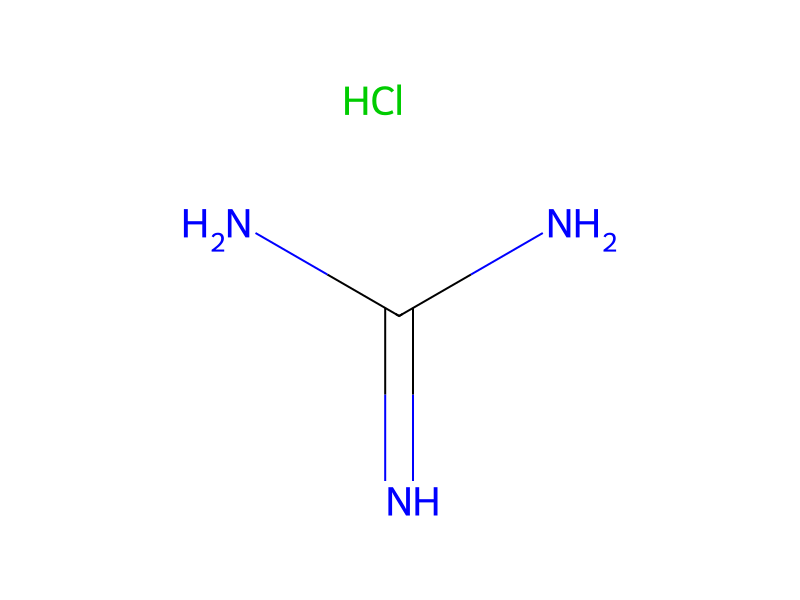
Guanidine Hydrochloride → 3-Amino-1,2,4-benzotriazine
Reaction equation

Cl.[NH2:2][C:3]([NH2:5])=[NH:4].CC([O-])(C)C.[K+].[N+:12]([C:15]1[CH:20]=[CH:19][CH:18]=[CH:17][CH:16]=1)([O-])=O>CS(C)=O>[NH2:4][C:3]1[N:5]=[N:12][C:15]2[CH:20]=[CH:19][CH:18]=[CH:17][C:16]=2[N:2]=1Participants
5
Reactant 3


Product 1

Reagents, catalysts & solvents 1

Procedure
To a stirring mixture of guanidine hydrochloride (160 mg, 1.7 mmol) and t-BuOK (670 mg, 6 mmol) in DMSO (4 mL) was added one portion of nitrobenzene (123 mg, 1 mmol) at room temperature. The mixture turned red in one minute. In 20 to 30 minutes the mixture was quenched with a saturated, aqueous solution of ammonium chloride. A yellow precipitate was formed and removed by filtration. The precipitate was then washed with water, dried in the air, and recrystallized from benzene or ethanol to give 105 mg (72%) of 3-amino-1,2,4-benzotriazine. The melting point was determined to be 203–205° C., consistent with the melting point (207° C.) of 3-amino-1,2,4-benzotriazine synthesized by other known methods (J. Chem. Soc. (B) (1970) 911).
Workup
- customIn 20 to 30 minutes the mixture was quenched with a saturated, aqueous solution of ammonium chloride
- customA yellow precipitate was formed
- customremoved by filtration
- washThe precipitate was then washed with water
- customdried in the air
- customrecrystallized from benzene or ethanol
Sources & evidence
- ORD record
- ord-ee9818244242460289efada25e1f7a5e
- Source dataset
- uspto-grants-2006_10
- Patent number
- US07129349B2
Reaction notes
Loading…