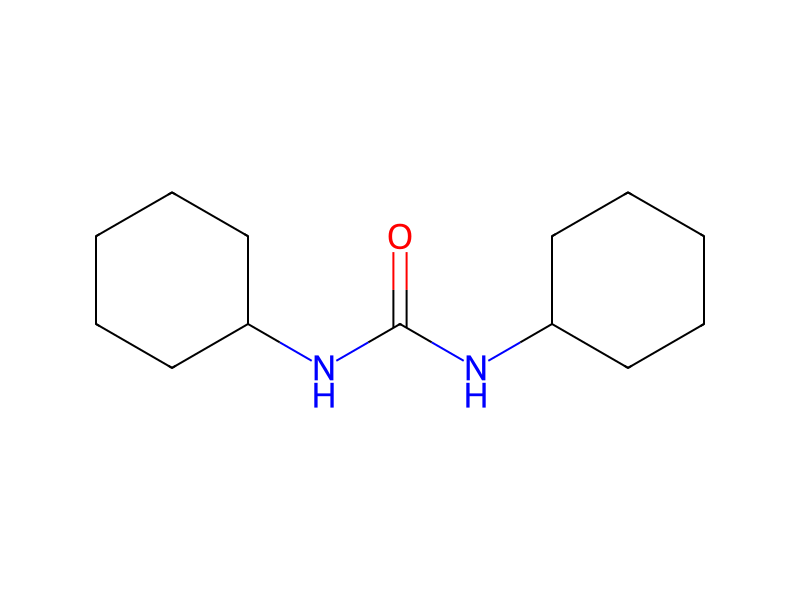
Dicyclohexylcarbodiimide → N,N'-Dicyclohexylurea
Reaction equation

C(O[C:16]1[CH:21]=[CH:20][CH:19]=[CH:18][C:17]=1[NH:22][C:23](C1C=C(SC2N(C3C=CC=C(C(O)=O)C=3)N=NN=2)C2C(=CC=CC=2)C=1O)=[O:24])CCCCCCCCCCCCC.C(NN[C:55]1[CH:60]=[CH:59][C:58]([NH2:61])=[CH:57][CH:56]=1)=O.C1(N=C=NC2CCCCC2)CCCCC1>CN(C=O)C>[C:23]([NH:61][CH:58]1[CH2:57][CH2:56][CH2:55][CH2:60][CH2:59]1)([NH:22][CH:17]1[CH2:18][CH2:19][CH2:20][CH2:21][CH2:16]1)=[O:24]Participants
Reactant 3



Product 1
Reagents, catalysts & solvents 1

Procedure
13.9 g of 2-(2-tetradecyloxyphenyl)carbamoyl-4-[1-(3-carboxyphenyl)-5-tetrazolylthio]-1-naphthol and 3.0 g of 1-formyl-2-(4-aminophenyl)hydrazine were dissolved in 20 ml of DMF and to the solution was added dropwise with stirring 5 ml of a DMF solution containing 4.1 g of dicyclohexylcarbodiimide at 0° C. under nitrogen atmosphere. After the completion of the addition, the mixture was stirred for 2 hours and then further stirred at room temperature for 2 hours. Dicyclohexylurea formed was removed by filtration and the filtrate was poured into 1.5 liters of water. The crystals thus deposited were collected by filtration and dissolved in 50 ml of DMF. After treating with active carbon the DMF solution was poured into 400 ml of methanol and the crystals thus deposited were collected by filtration to obtain 9.2 g of the desired Compound (15). Yield: 55.5%. Melting Point: 173° to 180° C.
Workup
- additionwas added dropwise
- additionAfter the completion of the addition
- stirringfurther stirred at room temperature for 2 hours
Sources & evidence
- ORD record
- ord-6ee2a14221f140f4bd4d9a777614e16a
- Source dataset
- uspto-grants-1986_12
- Patent number
- US04628024
Reaction notes
Loading…