3-Pyridinecarboxaldehyde → 4-(Pyridin-3-yl)but-3-en-2-one
Reaction equation

[N:1]1[CH:6]=[CH:5][CH:4]=[C:3]([CH:7]=O)[CH:2]=1.C1(P(C2C=CC=CC=2)(C2C=CC=CC=2)=[CH:16][C:17](=[O:19])[CH3:18])C=CC=CC=1>C1(C)C=CC=CC=1>[N:1]1[CH:6]=[CH:5][CH:4]=[C:3]([CH:7]=[CH:16][C:17](=[O:19])[CH3:18])[CH:2]=1Participants
4
Reactant 2
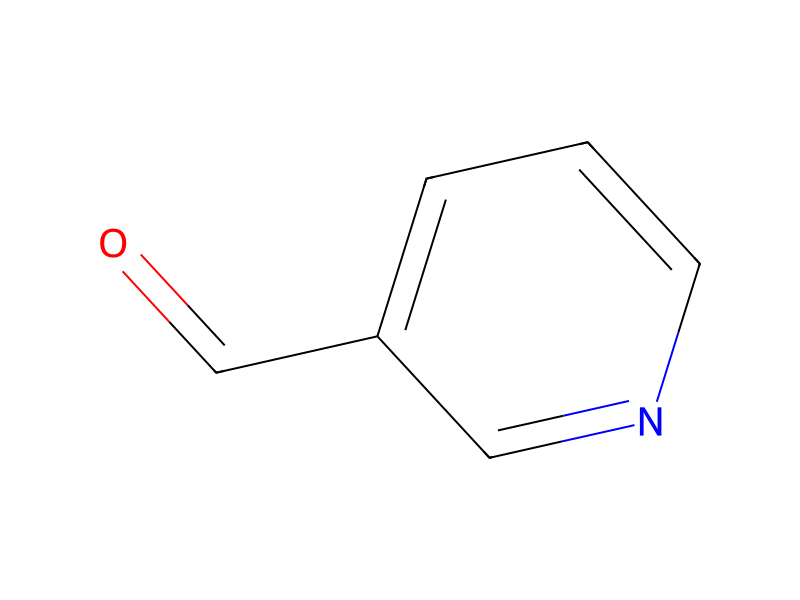

Product 1

Reagents, catalysts & solvents 1

Procedure
Pyridine-3-carboxaldehyde (18.9 ml) and 1-triphenylphosphoranylidene-2-propanone (70 g) were heated at reflux in toluene for 2 hr. The solvent was evaporated and the residue was distilled at reduced pressure to give 1-(3-pyridyl)but-1-en-3-one as an oil. Pmr spectrum (CDCl3 ; δ in ppm): 2.41 (3H, s); 6.79 (1H, d); 7.2-8.77 (4H, m); 7.52 (1H, d).
Workup
- customThe solvent was evaporated
- distillationthe residue was distilled at reduced pressure
Sources & evidence
- ORD record
- ord-fdba032fb1ab4c3b81626914406b07f2
- Source dataset
- uspto-grants-1986_12
- Patent number
- US04631081
Reaction notes
Loading…