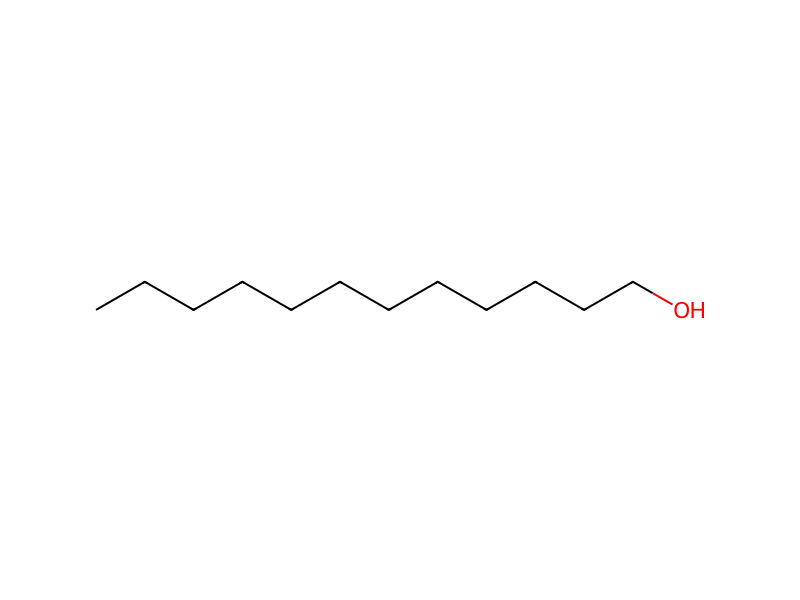
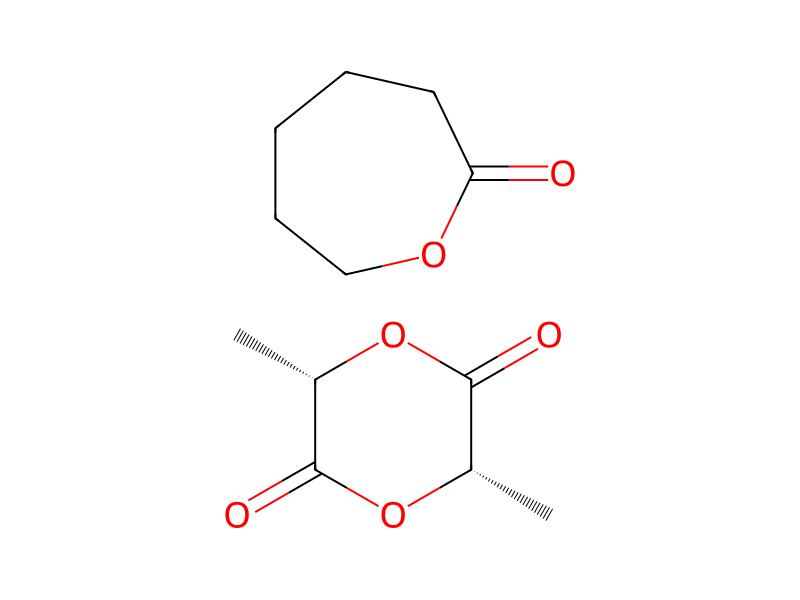
1-Dodecanol → L-lactide epsilon-caprolactone
Reaction equation

C(O)CCCCCCCCCCC.[CH3:14][CH2:15][CH2:16][CH2:17][CH:18]([C:21]([O-:23])=[O:22])[CH2:19]C.CCC[CH2:27][CH:28]([C:31]([O-:33])=[O:32])CC.[Sn+2]>>[C:21]1(=[O:23])[O:22][CH2:14][CH2:15][CH2:16][CH2:17][CH2:18]1.[CH3:27][C@@H:28]1[O:23][C:21](=[O:22])[C@H:18]([CH3:19])[O:33][C:31]1=[O:32]Participants
3

Procedure
The procedure in Example 1 was substantially repeated, except that 13.6 mL of 1-dodecanol instead of 4.00 mL of glycerol and 0.12 mL (40 μmol) instead of 0.10 mL of stannous octoate solution were used. The copolymer was dried under vacuum (0.1 mm Hg) at 110° C. for about 16 hours to remove any unreacted monomer. The copolymer had an inherent viscosity of 0.15 dL/g in HFIP at 25° C. The copolymer was viscous liquid at room temperature. The molar ratio of PCL/PLA was found to be 51.5/48.5 by proton NMR.
Workup
- customThe copolymer was dried under vacuum (0.1 mm Hg) at 110° C. for about 16 hours
- customto remove any unreacted monomer
- customat 25° C
- customat room temperature
Sources & evidence
- ORD record
- ord-02eaa3a24ae24741a7507bb38399e00e
- Source dataset
- uspto-grants-2002_01
- Patent number
- US06335383B1
Reaction notes
Loading…