Alumina → Cyclododecanol
Reaction equation

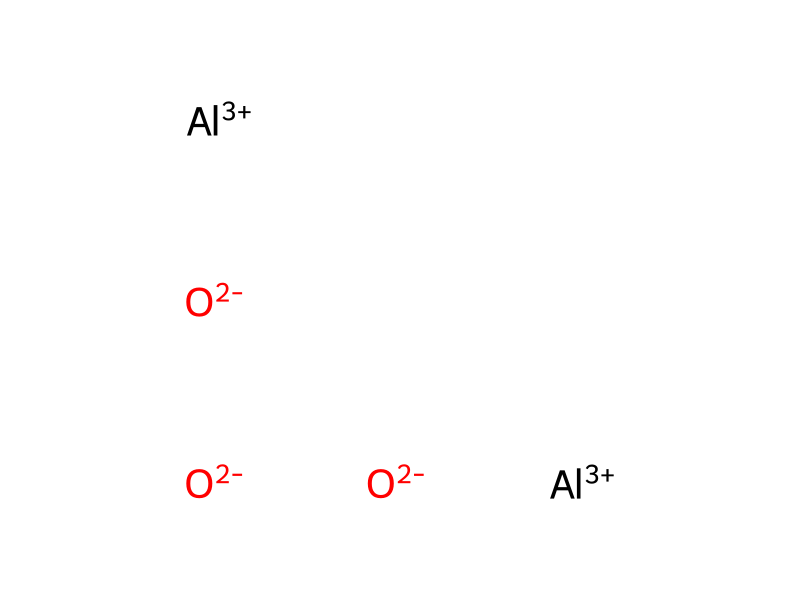
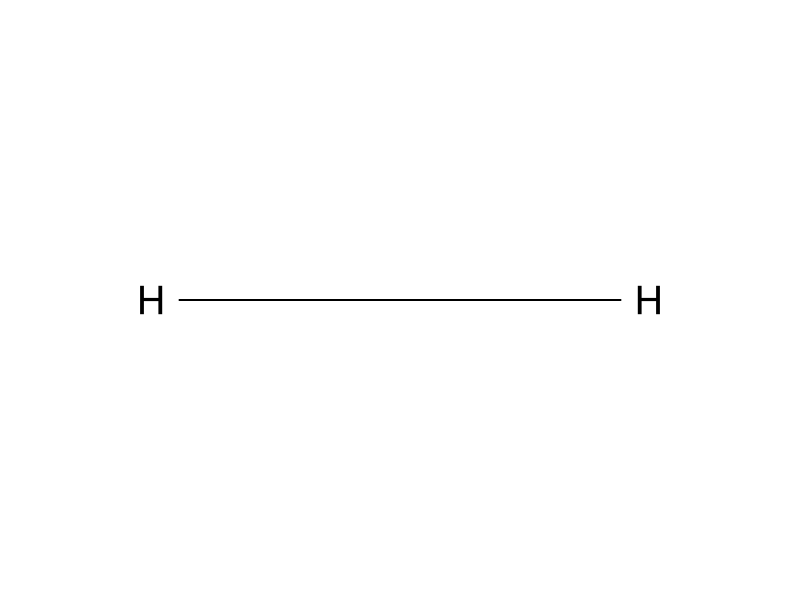
[O:1]1[C:3]2[CH:4]=[CH:5][CH2:6][CH2:7][CH2:8][CH2:9][CH2:10][CH2:11][CH2:12][CH2:13][C:2]1=2.[H][H].[O-2].[O-2].[O-2].[Al+3].[Al+3]>[Pd]>[CH:2]1([OH:1])[CH2:13][CH2:12][CH2:11][CH2:10][CH2:9][CH2:8][CH2:7][CH2:6][CH2:5][CH2:4][CH2:3]1Participants
Reactant 3

Product 1

Reagents, catalysts & solvents 1

Procedure
Also, it is known that epoxidized cycloalkanes and/or epoxidized cycloalkenes can be produced by epoxidizing corresponding cycloalkenes with a high yield. If the epoxidized compounds can be converted to corresponding cycloalkanones and cycloalkanols with a high efficiency, the cycloalkanones and the cycloalkanols can be expected to be obtained at a high yield. However, only a small number of reports can be found on methods of converting an epoxidized cycloalkane and/or an epoxidized cycloalkene to a mixture of cycloalkanone with cycloalkanol. For example, J. Mol. Catal., Vol. 69, pages 69 to 103 (1991) discloses a method of hydrogenating a monoepoxycyclododecadiene with hydrogen in the presence of a catalyst comprising palladium carried on a carrier consisting of γ-alumina, under a hydrogen gas pressure of 1.3 MPa at a temperature of 90° C. In this method, cyclododecanol was produced with a yield of 20% or less and no cyclododecanone was produced. When a catalyst comprising palladium carried on a carrier consisting of titania or silica was used in place of the above-mentioned palladium catalyst carried on γ-alumina, the yield of cyclododecanol was low and unsatisfactory.
Workup
- customcan be produced
- customto be obtained at a high yield
- customat a temperature of 90° C
Sources & evidence
- ORD record
- ord-8965c465e8af40daa8c2bb28687f2b49
- Source dataset
- uspto-grants-2002_01
- Patent number
- US06335472B1
Reaction notes
Loading…