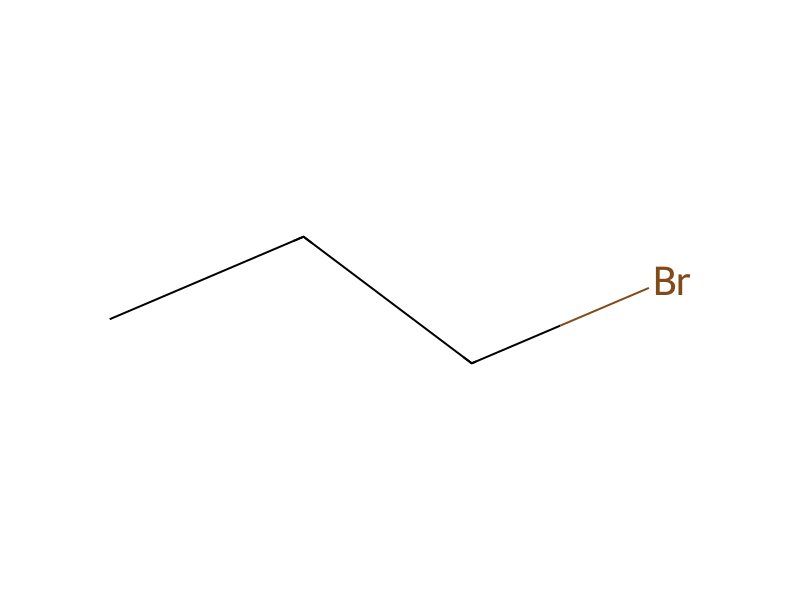
1-Bromopropane → 1-[1-(3-Chloro-5-methylphenyl)cyclobutyl]butylamine hydrochloride
Reaction equation

[Cl:1][C:2]1[CH:3]=[C:4]([C:9]2([C:13]#[N:14])[CH2:12][CH2:11][CH2:10]2)[CH:5]=[C:6]([CH3:8])[CH:7]=1.[CH2:15]([Mg]Br)[CH2:16][CH3:17].BrCCC.[Mg]>CCOCC>[ClH:1].[Cl:1][C:2]1[CH:3]=[C:4]([C:9]2([CH:13]([NH2:14])[CH2:15][CH2:16][CH3:17])[CH2:12][CH2:11][CH2:10]2)[CH:5]=[C:6]([CH3:8])[CH:7]=1Participants
Reactant 4



Product 1

Reagents, catalysts & solvents 1

Conditions
- Temperature
- 50 °C
Procedure
A solution of 1-(3-chloro-5-methylphenyl)-1-cyclobutanecarbonitrile (8.0 g) in ether (40 ml) was added to a solution of propyl magnesium bromide [prepared by the reaction of 1-bromopropane (6.7 g) and magnesium (1.3 g)] in ether (80 ml) and the mixture heated under reflux for two and a half hours. Two thirds of the ether was evaporated off and then, after cooling, a solution of sodium borohydride (3.5 g) in ethanol (150 ml) added. The mixture was maintained at 50° C. for one hour and water (50 ml) and then 5N hydrochloric acid (50 ml) added. The ether layer was separated, dried and evaporated to yield a solid which was recrystallised from propan-2-ol to give 1-[1-(3-chloro-5-methylphenyl)cyclobutyl]butylamine hydrochloride (m.p. 145°-146° C.).
Workup
- temperaturethe mixture heated
- temperatureunder reflux for two and a half hours
- customTwo thirds of the ether was evaporated off
- temperatureafter cooling
- additiona solution of sodium borohydride (3.5 g) in ethanol (150 ml) added
- additionwater (50 ml) and then 5N hydrochloric acid (50 ml) added
- customThe ether layer was separated
- customdried
- customevaporated
- customto yield a solid which
- customwas recrystallised from propan-2-ol
Sources & evidence
- ORD record
- ord-09292a68882f44c195eed65a67273e11
- Source dataset
- uspto-grants-1988_05
- Patent number
- US04746680
Reaction notes
Loading…