N-methyl-2-pyrrolidone → [(1-Chloro-3,3,4-trimethylpent-1-en-2-yl)oxy]benzene
Reaction equation

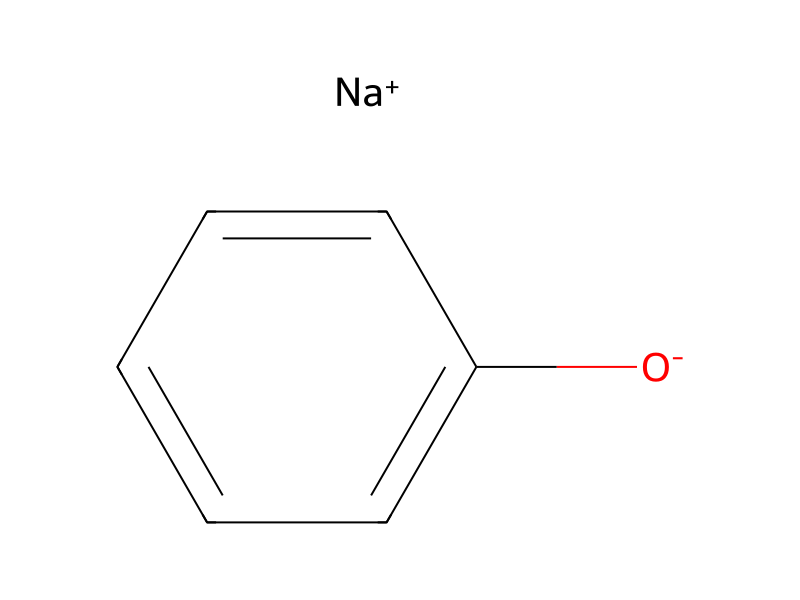
[C:1]1([O-:7])[CH:6]=[CH:5][CH:4]=[CH:3][CH:2]=1.[Na+].CN1CCCC1=O.[Cl:16][C:17](Cl)=[CH:18][C:19]([CH3:24])([CH3:23])[CH:20]([CH3:22])[CH3:21]>C(Cl)Cl>[Cl:16][CH:17]=[C:18]([O:7][C:1]1[CH:6]=[CH:5][CH:4]=[CH:3][CH:2]=1)[C:19]([CH3:24])([CH3:23])[CH:20]([CH3:22])[CH3:21]Participants




Conditions
- Temperature
- 200 °C
Procedure
487 g of sodium phenolate are introduced into 1.6 liters of N-methylpyrrolidone at about 100° C., and dissolved by heating the mixture to 200° C. 360 g (2 mols) of 1,1-dichloro-3,3,4-trimethyl-pent-1-ene are added dropwise in the course of 3 hours at a rate such that the temperature of the reaction mixture does not fall below 195° C. Thereafter, the mixture is heated at 200°-210° C. for 8 hours. Working-up is carried out by diluting the solution with methylene chloride and extracting it by shaking withh dilute sodium hydroxide solution. After drying and stripping off the solvent, 406 g of crude product remain, this product being distilled at 105°-120° C./0.1 mbar. 337 g (71% of theory) of 1-chloro-2-phenoxy-3,3,4-trimethyl-pent-1-ene are obtained. ##STR18##
Workup
- dissolutiondissolved
- customdoes not fall below 195° C
- temperatureThereafter, the mixture is heated at 200°-210° C. for 8 hours
- extractionextracting it
- customAfter drying
- distillationthis product being distilled at 105°-120° C./0.1 mbar
Sources & evidence
- ORD record
- ord-35e6bdee1bb34e1aa34a6016da6887ce
- Source dataset
- uspto-grants-1988_05
- Patent number
- US04747869
Reaction notes
Loading…