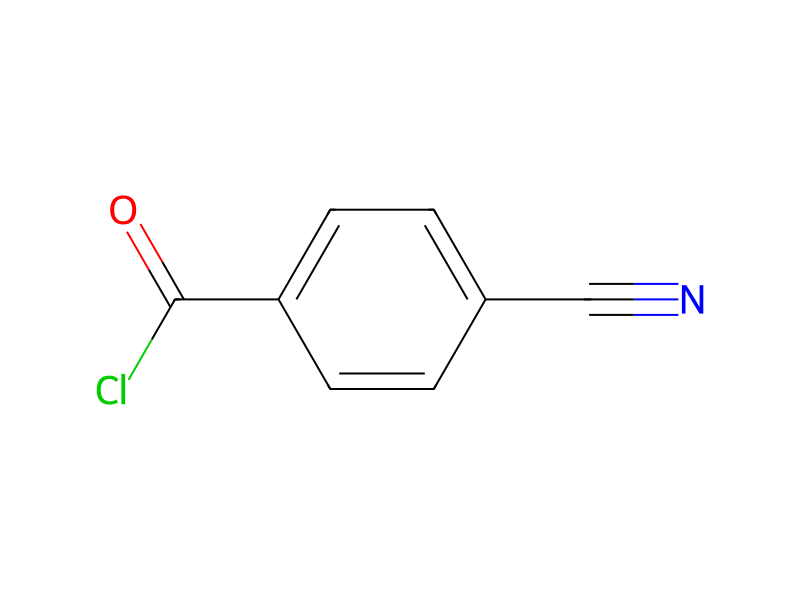
4-Cyanobenzoyl chloride → HCID 68707662, compound
Reaction equation

[C:1]([C:3]1[CH:11]=[CH:10][C:6]([C:7](Cl)=[O:8])=[CH:5][CH:4]=1)#[N:2].[NH2:12][C:13]([CH3:29])([CH2:16][N:17]1[N:21]=[C:20]2[C:22]([Br:28])=[CH:23][C:24]([Cl:27])=[C:25]([Br:26])[C:19]2=[N:18]1)[C:14]#[N:15]>C1COCC1>[Cl:27][C:24]1[CH:23]=[C:22]([Br:28])[C:20]2=[N:21][N:17]([CH2:16][C:13]([NH:12][C:7](=[O:8])[C:6]3[CH:10]=[CH:11][C:3]([C:1]#[N:2])=[CH:4][CH:5]=3)([C:14]#[N:15])[CH3:29])[N:18]=[C:19]2[C:25]=1[Br:26]Participants
4
Reactant 2

Product 1

Reagents, catalysts & solvents 1

Procedure
A solution of 4-cyanobenzoyl chloride (0.16 mmole) in THF was added to a solution of 2-amino-3-(5-chloro-4,7-dibromo-2H-benzotriazol-2-yl)-2-methylpropionitrile (0.075 mmole, described in Example 53) in THF mixed with TEA (3% v./v.). The reaction mixture was stirred 12 hours at room temperature then heated to 45° C. for 6 hours before solvent was evaporated under reduced pressure. The resulting crude product was dissolved in DMSO and purify by semi-preparative HPLC. The desired fractions were collected and evaporated under reduced pressure. The title compound was isolated as solid residue (10.8 mg) that was dissolved in DMSO for further biological evaluation and analyzed by LCMS. MS (ES): M/Z [M+H]=521, RT=0.66 min.
Workup
- temperaturethen heated to 45° C. for 6 hours before solvent
- customwas evaporated under reduced pressure
- dissolutionThe resulting crude product was dissolved in DMSO
- custompurify by semi-preparative HPLC
- customThe desired fractions were collected
- customevaporated under reduced pressure
Sources & evidence
- ORD record
- ord-5425cc7deaac40fca170503bf36650ae
- Source dataset
- uspto-grants-2013_06
- Patent number
- US08461176B2
Reaction notes
Loading…