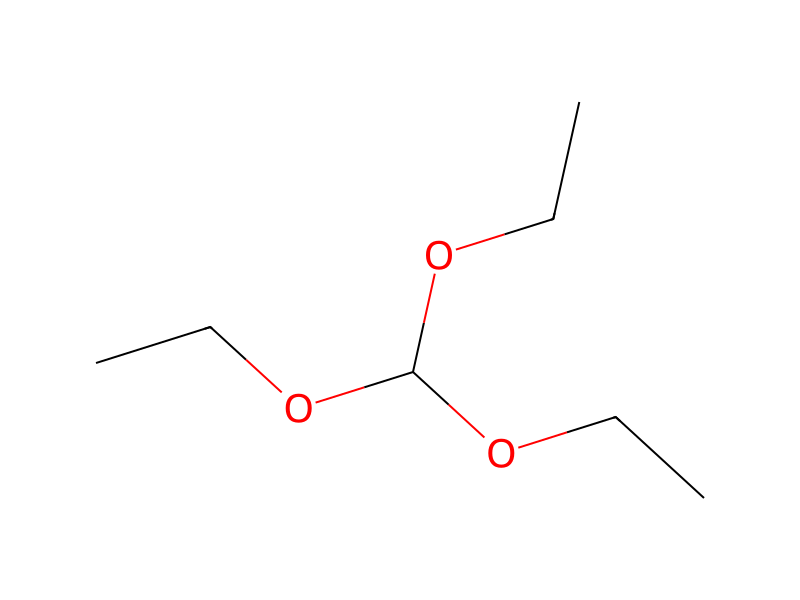
Ethyl orthoformate → 2-Bromo-4-(diethoxymethyl)-1-fluorobenzene
Reaction equation

[Br:1][C:2]1[CH:3]=[C:4]([CH:7]=[CH:8][C:9]=1[F:10])C=O.[CH:11]([O:18][CH2:19][CH3:20])([O:15][CH2:16][CH3:17])OCC.[Br-].[Br-].[Br-].C([N+](CCCC)(CCCC)CCCC)CCC.C([N+](CCCC)(CCCC)CCCC)CCC.C([N+](CCCC)(CCCC)CCCC)CCC.C([O-])(O)=O.[Na+]>CCO>[Br:1][C:2]1[CH:3]=[C:4]([CH:11]([O:15][CH2:16][CH3:17])[O:18][CH2:19][CH3:20])[CH:7]=[CH:8][C:9]=1[F:10]Participants
6





Procedure
A 250 mL flask was charged with 3-bromo-4-fluorobenzaldehyde (13.5 g, 66.5 mmol), triethyl orthoformate (13.3 mL, 79.8 mmol), and anhydrous EtOH (150 mL). Tetrabutylammonium tribromide was added and the reaction mixture was allowed to stir at room temperature for 48 hours. The crude reaction was poured into aqueous NaHCO3 and extracted with ethyl acetate (75 ml). The organic layers were combined, dried with Na2SO4 and reduced under vacuum to afford the intermediate (16.2 g, 88%) as a clear oil. 1HNMR (CDCl3) δ ppm: 7.71 (1H), 7.40 (1H), 7.12 (1H), 5.48 (1H), 3.65-3.51 (4H), 1.28-1.24 (6H).
Workup
- customThe crude reaction
- extractionextracted with ethyl acetate (75 ml)
- dry with materialdried with Na2SO4
Sources & evidence
- ORD record
- ord-f22ef037af9c4dfdbb2d440d98760b1b
- Source dataset
- uspto-grants-2013_06
- Patent number
- US08466115B2
Reaction notes
Loading…