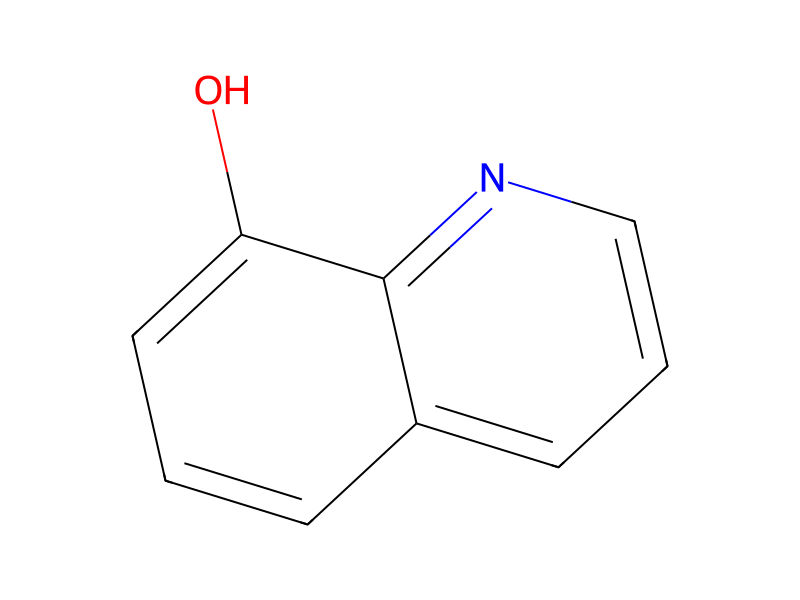
N,N-Diethylethanamine trihydrofluoride → 8-Hydroxyquinoline
Reaction equation

C(C1C=CC([C:11]2[CH:20]=[CH:19][C:18]([O:21][Si](C(C)(C)C)(C)C)=[C:17]3[C:12]=2[CH:13]=[CH:14][C:15](C)=[N:16]3)=CC=1)(C)(C)C.F.F.F.C(N(CC)CC)C>C1COCC1>[OH:21][C:18]1[CH:19]=[CH:20][CH:11]=[C:12]2[C:17]=1[N:16]=[CH:15][CH:14]=[CH:13]2Participants
4
Reactant 2


Product 1
Reagents, catalysts & solvents 1

Procedure
To a 300 mL flask was added 6.7 g of 5-(4-t-butyl-phenyl)-2-methyl-8-t-butyldimethylsiloxyquinoline and 100 ml dry THF. The mixture was stirred under nitrogen while 13.5 ml triethylamine trihydrofluoride (Aldrich) was added in 5 portions over 30 min. The reaction mixture was stirred at room temperature for 2 h and the solvents removed in vacuo. The resulting oil was purified by silica chromatography, first eluting with 15% dichloromethane in hexanes and then collecting the product by elution with 50% dichloromethane in hexanes to give 4.33 g of the desired product quinaldine 2a as a colorless solid.
Workup
- additionwas added in 5 portions over 30 min
- customthe solvents removed in vacuo
- customThe resulting oil was purified by silica chromatography
- washfirst eluting with 15% dichloromethane in hexanes
- customcollecting the product
- washby elution with 50% dichloromethane in hexanes
Sources & evidence
- ORD record
- ord-9c843249ef3f4976accc597d4eacf014
- Source dataset
- uspto-grants-2013_06
- Patent number
- US08470208B2
Reaction notes
Loading…