1,4-Dibromobutane → HCID 13232499, compound
Reaction equation

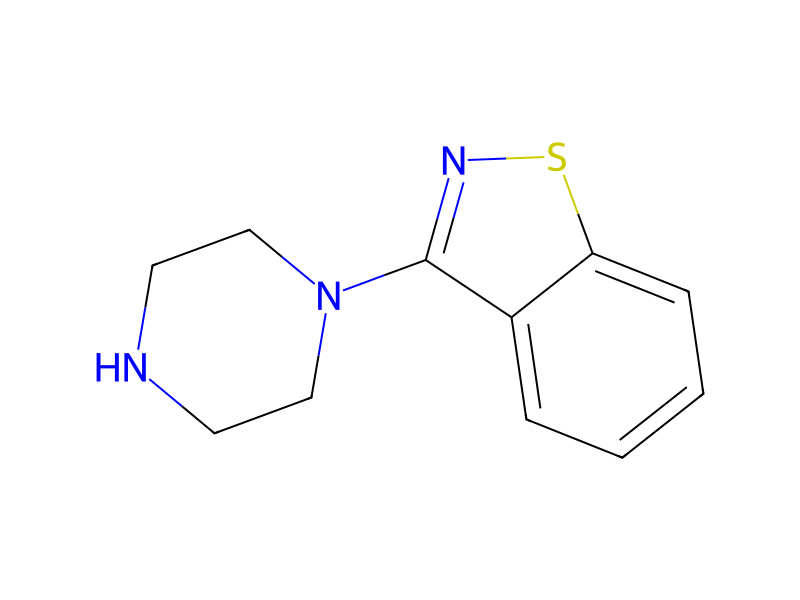
[N:1]1([C:7]2[C:11]3[CH:12]=[CH:13][CH:14]=[CH:15][C:10]=3[S:9][N:8]=2)[CH2:6][CH2:5][NH:4][CH2:3][CH2:2]1.[Br:16][CH2:17][CH2:18][CH2:19][CH2:20]Br.C(=O)([O-])[O-].[K+].[K+]>C(O)C>[Br-:16].[S:9]1[C:10]2[CH:15]=[CH:14][CH:13]=[CH:12][C:11]=2[C:7]([N:1]2[CH2:6][CH2:5][N+:4]3([CH2:20][CH2:19][CH2:18][CH2:17]3)[CH2:3][CH2:2]2)=[N:8]1Participants
5
Reactant 3


Product 1

Reagents, catalysts & solvents 1

Procedure
Method B--A mixture of 3-(1-piperazinyl)-1,2-benzisothiazole (5.0 g., 0.0228 mole), 1,4-dibromobutane (9.8 g., 0.0456 mole) and finely powdered anhydrous potassium carbonate (7.9 g., 0.057 mole) in 100 ml. of ethanol is stirred and refluxed for a 16 hr. period. The cooled reaction mixture is filtered and the filtrate concentrated in vacuo. Residual solid heated to reflux with 70 ml. of isopropanol and filtered. Concentration of the filtrate to about one-half volume and refrigeration affords 5.58 g. (69.1% yield) of 8-(1,2-benzisothiazol-3-yl)-8-aza-5-azoniaspiro[4.5]decane bromide, m.p. 246.5°-253° C.
Workup
- temperaturerefluxed for a 16 hr
- customThe cooled reaction mixture
- filtrationis filtered
- concentrationthe filtrate concentrated in vacuo
- temperatureResidual solid heated
- temperatureto reflux with 70 ml
- filtrationof isopropanol and filtered
- customConcentration of the filtrate to about one-half volume and refrigeration affords 5.58 g
Sources & evidence
- ORD record
- ord-b62709017fc04b1383c5c80df1f75673
- Source dataset
- uspto-grants-1984_06
- Patent number
- US04452799
Reaction notes
Loading…