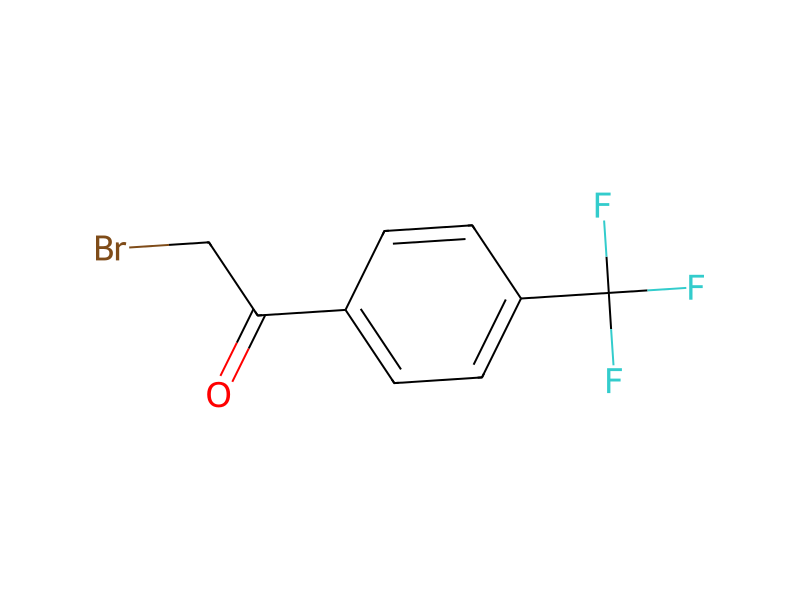
2-Bromo-4'-(trifluoromethyl)acetophenone → Methyl 4-[4-(4-trifluoromethylphenyl)-2-oxazolyl]benzoate
Reaction equation

[C:1]([C:4]1[CH:13]=[CH:12][C:7]([C:8]([O:10][CH3:11])=[O:9])=[CH:6][CH:5]=1)(=[O:3])[NH2:2].[F:14][C:15]([F:27])([F:26])[C:16]1[CH:25]=[CH:24][C:19]([C:20](=O)[CH2:21]Br)=[CH:18][CH:17]=1>>[F:14][C:15]([F:26])([F:27])[C:16]1[CH:17]=[CH:18][C:19]([C:20]2[N:2]=[C:1]([C:4]3[CH:13]=[CH:12][C:7]([C:8]([O:10][CH3:11])=[O:9])=[CH:6][CH:5]=3)[O:3][CH:21]=2)=[CH:24][CH:25]=1Participants
3


Procedure
In the same manner as in Example 1, methyl 4-carbamoylbenzoate was reacted with 4-trifluoromethylphenacyl bromide to obtain methyl 4-[4-(4-trifluoromethylphenyl)-2-oxazolyl]benzoate. The product was recrystallized from ethanol. Yield: 30%. Pale yellow prisms. Melting Point: 182 to 183° C.
Sources & evidence
- ORD record
- ord-bf02b70999c5486b8c7a9af558dddc71
- Source dataset
- uspto-grants-2003_04
- Patent number
- US06545009B1
Reaction notes
Loading…