Sodium amide → Ethyl 1-methylcyclopropanecarboxylate
Reaction equation

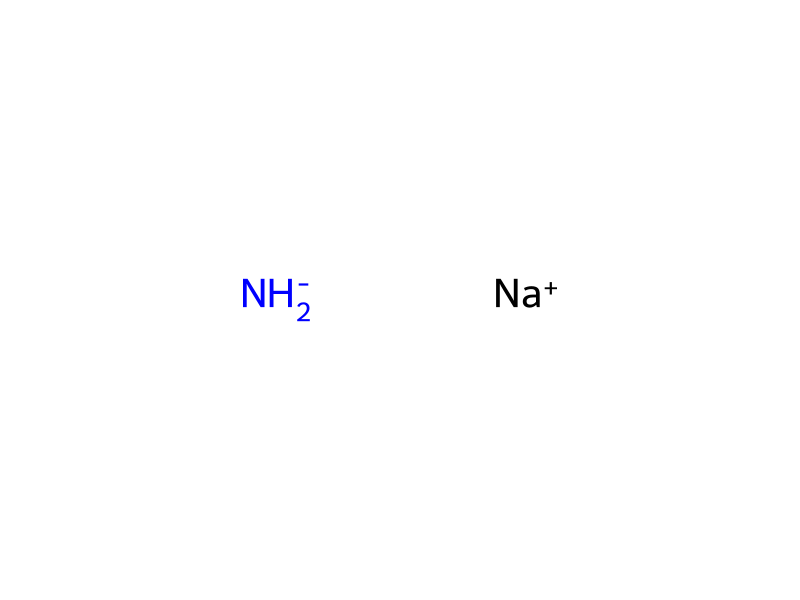
[CH2:1]([O:3][C:4](=[O:10])[CH:5]([CH3:9])[CH2:6][CH2:7]Cl)[CH3:2].[NH2-].[Na+]>C1C=CC=CC=1>[CH2:1]([O:3][C:4]([C:5]1([CH3:9])[CH2:7][CH2:6]1)=[O:10])[CH3:2]Participants
Reactant 2

Product 1

Reagents, catalysts & solvents 1

Procedure
Cannon and coworkers (J. Am. Chem. Soc., 1959, 81, pages 1660-1666) disclose the reaction of α-methyl-γ-chlorobutyric acid ethyl ester with sodamide under strictly anhydrous conditions in benzene to provide 1-methylcyclopropane carboxylic acid ethyl ester in a yield of 47.6%. Schwarze and coworkers, U.S. Pat. No. 4,520,209, disclose the reaction of methyl 4-chloro-2-methylbutyrate in methanol with an excess of sodium methylate at a reaction temperature of 90° C. or higher. Although, an 87% yield was claimed by Schwarze et al., wiped film distillation or extraction was required to the separate methyl 1-methylcyclopropanecarboxylate from the sodium chloride by-product. Schwarze and coworkers disclose a boiling point for methyl 1-methylcyclopropanecarboxylate of 136° C. German Patent Publication DE 3026094 discloses the conversion of 4-chloro-2-methylbutyrate to 1-methylcyclopropaneamide via sodium methoxide/ammonia in an autoclave at 145° C.
Sources & evidence
- ORD record
- ord-94844e4ed245485a886e97fddbbaecd8
- Source dataset
- uspto-grants-2003_04
- Patent number
- US06552217B2
Reaction notes
Loading…