Acetic acid, 2-(triphenylphosphoranylidene)-, ethyl ester → Ethyl 4-(3-bromophenyl)butanoate
Reaction equation

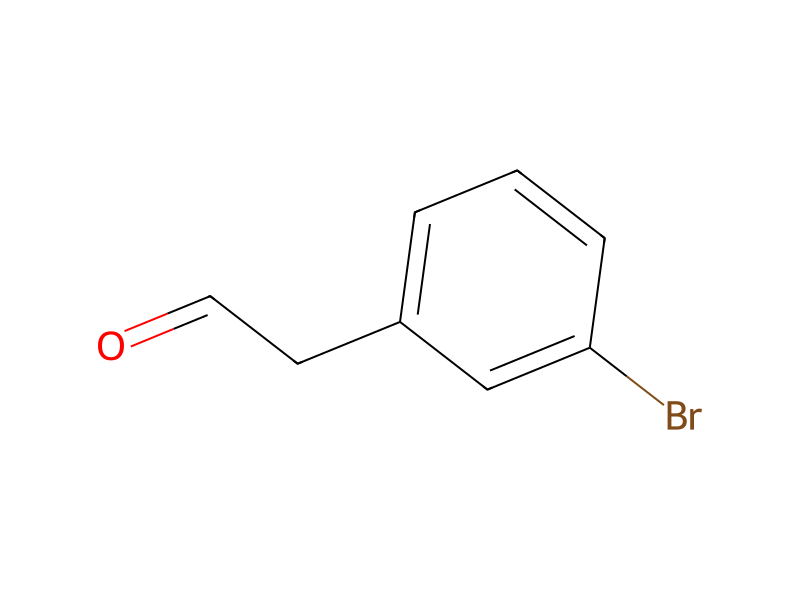
[Br:1][C:2]1[CH:3]=[C:4]([CH2:8][CH:9]=O)[CH:5]=[CH:6][CH:7]=1.[C:11]([CH:16]=P(C1C=CC=CC=1)(C1C=CC=CC=1)C1C=CC=CC=1)([O:13][CH2:14][CH3:15])=[O:12]>>[Br:1][C:2]1[CH:3]=[C:4]([CH2:8][CH2:9][CH2:16][C:11]([O:13][CH2:14][CH3:15])=[O:12])[CH:5]=[CH:6][CH:7]=1Participants


Procedure
Important starting materials for the synthesis of the preferred compounds of the invention are 6-bromo-1,2,3,4-tetrahydro-1,1-dimethylnaphthalene (Compound F), 7-bromo-3,4-dihydro-4,4-dimethylnaphthalen-1-one (Compound G), and the isomeric bromo compound, 6-bromo-3,4-dihydro-4,4-dimethylnaphthalen-1(2H)-one (Compound H). Compound G can be obtained as described in J. Med. Chem. 1995, 38, 4764-4767, and as shown in Reaction Scheme 1. Thus, referring now specifically to Reaction Scheme 1, ethyl 3-bromophenylacetate (Compound B, made by esterification of 3-bromophenylacetic acid) is reduced with diisobutylaluminum hydride (DIBAL H) to yield (3-bromophenyl)acetaldehyde. (3-Bromophenyl)acetaldehyde is reacted in a Wittig reaction with (carbethoxymethylene)triphenylphosphorane to provide a mixture of E and Z ethyl 4-(3-bromophenyl)but-2-enoates. The latter compounds are hydrogenated to yield ethyl 4-(3-bromophenyl)butanoate (Compound D). Compound D is reacted with the Grignard reagent derived from methylbromide to give the tertiary alcohol 5-(3-bromophenyl)-2-methylpentan-2-ol (Compound E) (It should be apparent to those skilled in the art, that the choice of the Grignard reagent used in this reaction step determines the nature of the R1 substituent in the resulting compounds of the invention.) Compound E is then treated with acid to cyclize it and to form 6-bromo-1,2,3,4-tetrahydro-1,1-dimethylnaphthalene (Compound F). Compound F is oxidized with chromium trioxide to yield 7-bromo-3,4-dihydro-4,4-dimethylnaphthalen-1(2H)-one (Compound G). The isomeric compound, 6-bromo-3,4-dihydro-4,4-dimethylnaphthalen-1(2H)-one (Compound H) can be obtained, starting with ethyl (4-bromophenyl)acetate, in accordance with the sequence of reactions illustrated in Reaction Scheme 1 for Compound G.
Workup
- customto provide
Sources & evidence
- ORD record
- ord-bc2d4e0570734e4598bde9255d7a352c
- Source dataset
- uspto-grants-2003_04
- Patent number
- US06555690B2
Reaction notes
Loading…