Butyl butyrate → (2S)-2-hydroxy-2-(3-phenoxyphenyl)acetonitrile
Reaction equation

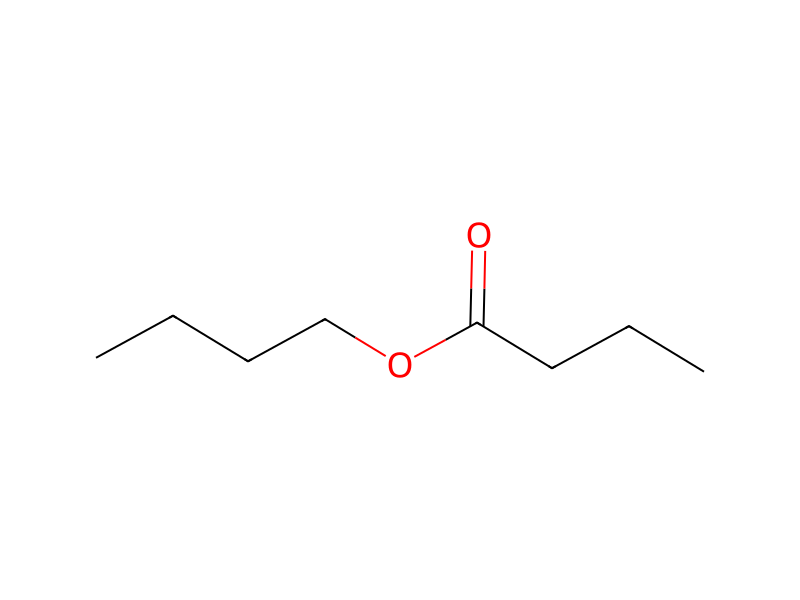
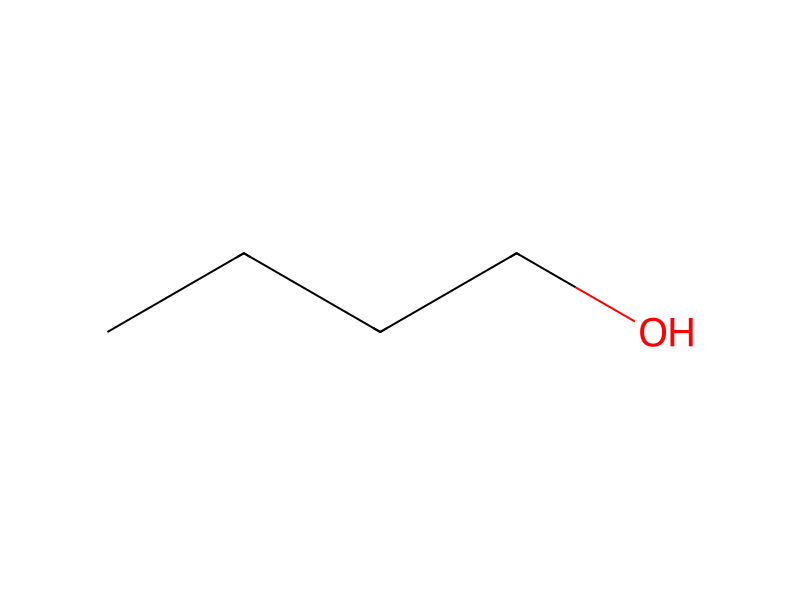
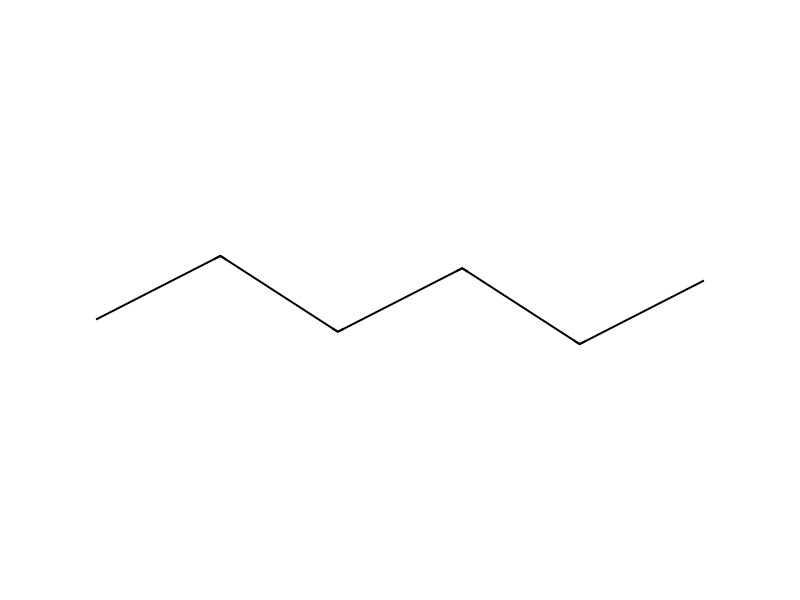
[OH:1][C@H:2]([C:5]1[CH:10]=[CH:9][CH:8]=[C:7]([O:11][C:12]2[CH:17]=[CH:16][CH:15]=[CH:14][CH:13]=2)[CH:6]=1)[C:3]#[N:4].C(OCCCC)(=O)CCC>CCCCCC.C(O)CCC>[OH:1][C@@H:2]([C:5]1[CH:10]=[CH:9][CH:8]=[C:7]([O:11][C:12]2[CH:17]=[CH:16][CH:15]=[CH:14][CH:13]=2)[CH:6]=1)[C:3]#[N:4]Participants
Reactant 2

Product 1

Reagents, catalysts & solvents 2
Conditions
- Temperature
- 25 °C
Procedure
The racemic ester, (R,S)-Cyano(3-phenoxyphenyl)methyl butyrate, (750 g) prepared by the method described in literature by Fadnavis and co-workers (Fadnavis, N. W.; Luke Babu, R.; Sheelu, G.; DeshpandeA Tetrahedron Asymmetry 2000, 11, 3303–3309) is dissolved in a mixture of hexane (11 lit) and n-butanol (700 ml). The enzyme lipase from Candida rugosa (EC 3.1.1.3, Type VII, Sigma, USA) was immobilized in gelatin matrix according to the procedure described in literature by Fadnavis and Koteshwar (Fadnavis, N. W. and Koteshwar, K. Biotechnology Progress, 1999, 15, 98–104). The enzyme powder of average particle size 1 mm (1.5 Kg powder, 250 g enzyme) was placed in the reactor and the reaction mixture of the racemic ester in hexane was circulated at a flow rate of 85 ml/min through the enzyme reactor. The reaction temperature was maintained at 25° C. by means of a constant temperature circulating water bath. The progress of the reaction was monitored by chiral HPLC as described in literature by Fadnavis and co-workers (Fadnavis, N. W.; Luke Babu, R.; Sheelu. G.; Deshpande. A. J. Chromatography A 2000, 189–193). The reaction was continued till almost all of the (R)-ester had reacted (8 h, 49% conversion) and the reaction came to a standstill. The reaction mixture was then drained from the bioreactor and the cycle was repeated The recovered reaction mixture consisting of unreacted (S)-ester, (R)-α-hydroxy-3-phenoxy-benzeneacetonitrile and butyl butyrate was then treated further to obtain (S)-α-hydroxy-3-phenoxy-benzeneacetonitrile as described in literature by Fadnavis and co-workers (Fadnavis, N. W.; Luke Babu, R.; Sheelu, G.; Deshpande, A. Tetrahedron Asymmetry 2001, 12, 1695–1699). The enzyme placed in the bioreactor was used over 50 cycles over a period of one month without loss of activity (<5%).
Workup
- customhad reacted (8 h, 49% conversion)
- customThe recovered reaction mixture
- additionwas then treated further
Sources & evidence
- ORD record
- ord-e3f789ed741c46818f259242d62e5c46
- Source dataset
- uspto-grants-2007_04
- Patent number
- US07198941B2
Reaction notes
Loading…