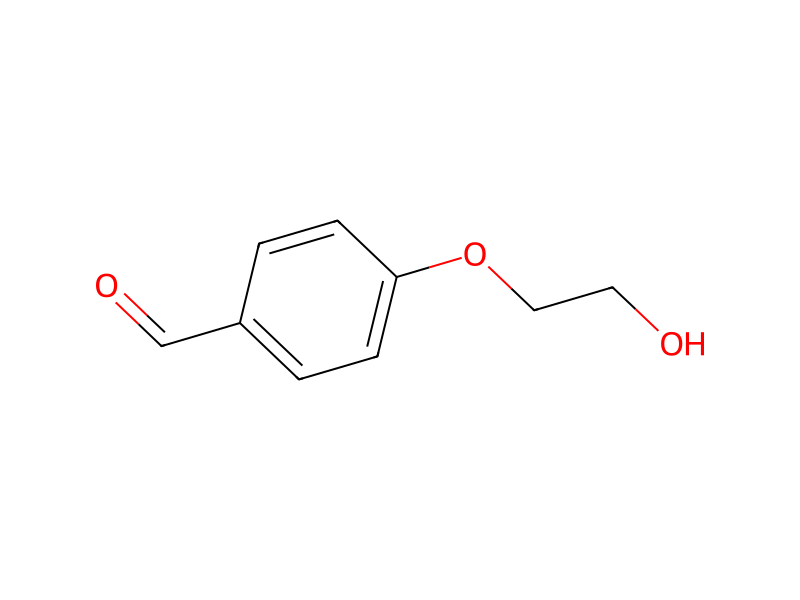
4-Hydroxybenzaldehyde → Benzaldehyde, 4-(2-hydroxyethoxy)-
Reaction equation

[OH:1][CH2:2][CH2:3][O:4][C:5]1[CH:12]=[CH:11][C:8]([CH:9]=C)=[CH:7][CH:6]=1.[OH:13]C1C=CC(C=O)=CC=1>>[OH:1][CH2:2][CH2:3][O:4][C:5]1[CH:12]=[CH:11][C:8]([CH:9]=[O:13])=[CH:7][CH:6]=1Participants
3


Procedure
Woods et al. (U.S. Pat. No. 5,019,629) describe a two-step procedure for preparing p-(2-hydroxyethoxy)styrene starting with p-hydroxybenzaldehyde. In the first step, p-(2-hydroxyethoxy)benzaldehyde is formed by reacting p-hydroxybenzaldehyde with ethylene carbonate in the presence of potassium carbonate. In the second step, p-(2-hydroxyethoxy)styrene is formed by reacting the isolated p-(2-hydroxyethoxy)benzaldehyde with methyltriphenylphosphonium bromide in the presence of sodium amide.
Sources & evidence
- ORD record
- ord-f70bfa49f7e64fe7968c69edea5b4b7f
- Source dataset
- uspto-grants-2007_04
- Patent number
- US07199272B2
Reaction notes
Loading…