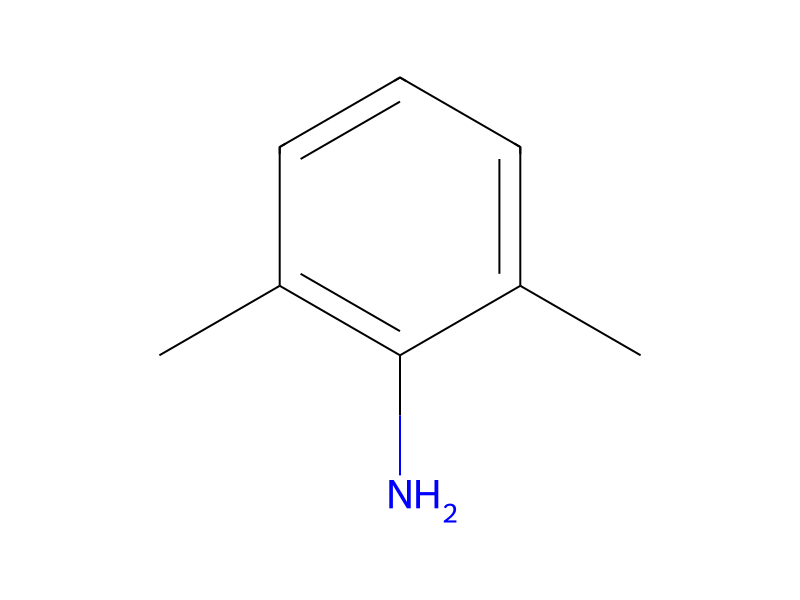
2,6-Dimethylaniline → HCID 12905103, compound
Reaction equation

[CH3:1][C:2]1[CH:8]=[CH:7][CH:6]=[C:5]([CH3:9])[C:3]=1[NH2:4].Br[CH:11]([CH3:17])[C:12]([O:14][CH2:15][CH3:16])=[O:13]>C1C=CC=CC=1>[CH3:1][C:2]1[CH:8]=[CH:7][CH:6]=[C:5]([CH3:9])[C:3]=1[NH:4][CH:11]([CH3:17])[C:12]([O:14][CH2:15][CH3:16])=[O:13]Participants
Reactant 2

Product 1

Reagents, catalysts & solvents 1

Procedure
Chem. Soc. (1961), 3,303-3,308 discloses that 2,6-dimethylaniline and ethyl α-bromopropionate can be reacted in benzene to give ethyl α-(2,6-dimethylanilino)propionate. Though the reaction time is 96 hours, the yield achievable is only 37 percent. As is shown, however, in Chemische Berichte, 22 (1889), 1,792-1,795, the yield is virtually quantitative if the two sterically hindering substituents in the 2,6-position are absent, ie. if aniline is used as the starting material. A comparison of the reaction of aniline and of ortho-methylaniline with ethyl 2-chloropropionate for 12 hours at 120°-125° C. in the presence of sodium acetate (C.R. Acad. Sc. Paris, 264 (Series C, 1967), 1,864-1,865) shows a yield of 40 percent based on aniline and 20 percent based on ortho-methylaniline, and thus shows the effect of even one ortho-substituent. The same reaction with the methyl group in the meta-position or para-position instead of the ortho-position gives yields of 33 and 57 percent. Accordingly, the yield increases the more remote the substituent is from the amino group.
Sources & evidence
- ORD record
- ord-ac2e048cbb2e4bfb9001fb5b389209b7
- Source dataset
- uspto-grants-1981_03
- Patent number
- US04255587
Reaction notes
Loading…