4-(3-Chloropropylthio)-3-methyl-2-[(4-pyridinylthio)methyl]pyridine → 2-{5-[3-Methyl-2-[(4-pyridinylthio)methyl]-4-pyridinyl]-1,5-dithiapentyl}pyridine-3-carboxylic acid
Reaction equation

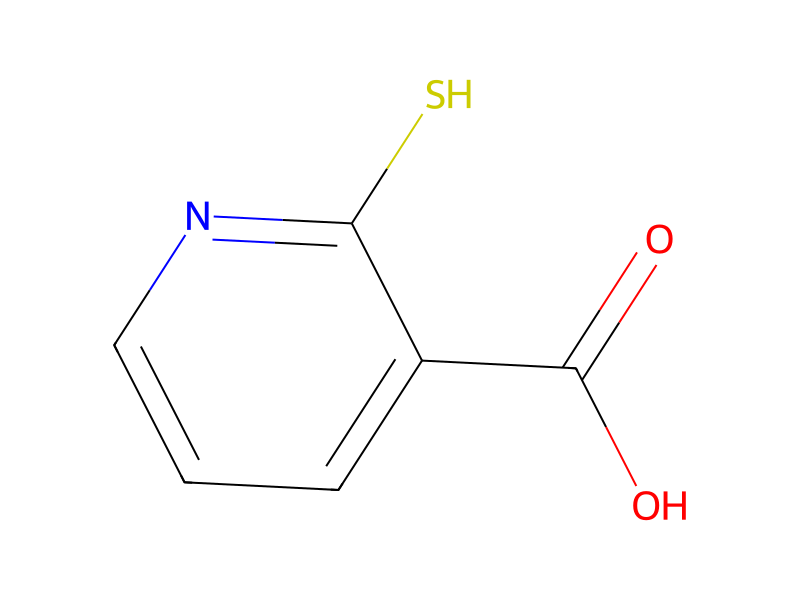
Cl[CH2:2][CH2:3][CH2:4][S:5][C:6]1[CH:11]=[CH:10][N:9]=[C:8]([CH2:12][S:13][C:14]2[CH:19]=[CH:18][N:17]=[CH:16][CH:15]=2)[C:7]=1[CH3:20].[SH:21][C:22]1[N:30]=[CH:29][CH:28]=[CH:27][C:23]=1[C:24]([OH:26])=[O:25]>>[CH3:20][C:7]1[C:8]([CH2:12][S:13][C:14]2[CH:19]=[CH:18][N:17]=[CH:16][CH:15]=2)=[N:9][CH:10]=[CH:11][C:6]=1[S:5][CH2:4][CH2:3][CH2:2][S:21][C:22]1[C:23]([C:24]([OH:26])=[O:25])=[CH:27][CH:28]=[CH:29][N:30]=1Participants
3


Procedure
According to the procedure indicated in Example 21, reaction of 4-(3-chloropropylthio)-3-methyl-2-[(4-pyridinylthio)methyl]pyridine with 2-mercaptonicotinic acid, and subsequent establishment of a pH of about 6 gives the title compound as a colorless solid; m.p. 219° C., dec.; yield 57% of theory.
Sources & evidence
- ORD record
- ord-b48e1accb3f94706acd63574ad9d9255
- Source dataset
- uspto-grants-2000_12
- Patent number
- US06162809
Reaction notes
Loading…