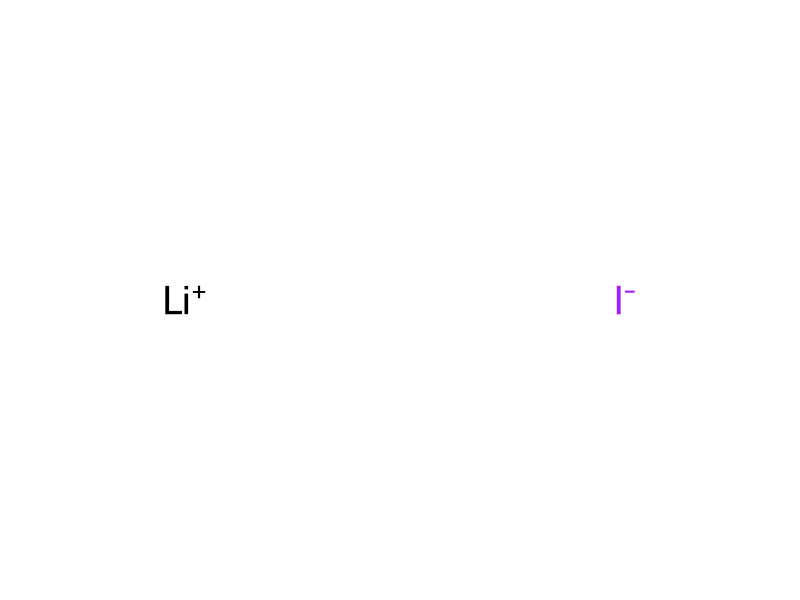
Lithium iodide → 2-Chloro-4-methylsulfonyl-3-(1,3,4-oxadiazol-2-yl)benzoic acid
Reaction equation

[Cl:1][C:2]1[C:11]([C:12]2[O:13][CH:14]=[N:15][N:16]=2)=[C:10]([S:17]([CH3:20])(=[O:19])=[O:18])[CH:9]=[CH:8][C:3]=1[C:4]([O:6]C)=[O:5].[I-].[Li+]>N1C=CC=CC=1>[Cl:1][C:2]1[C:11]([C:12]2[O:13][CH:14]=[N:15][N:16]=2)=[C:10]([S:17]([CH3:20])(=[O:19])=[O:18])[CH:9]=[CH:8][C:3]=1[C:4]([OH:6])=[O:5]Participants
4



Procedure
At reflux temperature, 1.5 g (4.7 mmol) of methyl 2-chloro-4-methylsulfonyl-3-(1,3,4-oxadiazol-2-yl)benzoate in 50 ml of pyridine were added dropwise to 2.5 g (18.9 mmol) of lithium iodide in 50 ml of pyridine, and the mixture was heated under reflux until the reaction had gone to completion. The mixture was cooled, the solvent was removed, the residue was taken up in water, insoluble components were filtered off and the mixture was acidified using hydrochloric acid and extracted with methylene chloride or ethyl acetate. The combined organic phases were dried and concentrated. 1.2 g (86% of theory) of 2-chloro-4-methylsulfonyl-3-(1,3,4-oxadiazol-2-yl)benzoic acid were obtained.
Workup
- temperaturethe mixture was heated
- temperatureunder reflux until the reaction
- temperatureThe mixture was cooled
- customthe solvent was removed
- filtrationinsoluble components were filtered off
- extractionextracted with methylene chloride or ethyl acetate
- customThe combined organic phases were dried
- concentrationconcentrated
Sources & evidence
- ORD record
- ord-1a665b3ce2fe4362a54bdac6c45a2db8
- Source dataset
- uspto-grants-2000_12
- Patent number
- US06165944
Reaction notes
Loading…