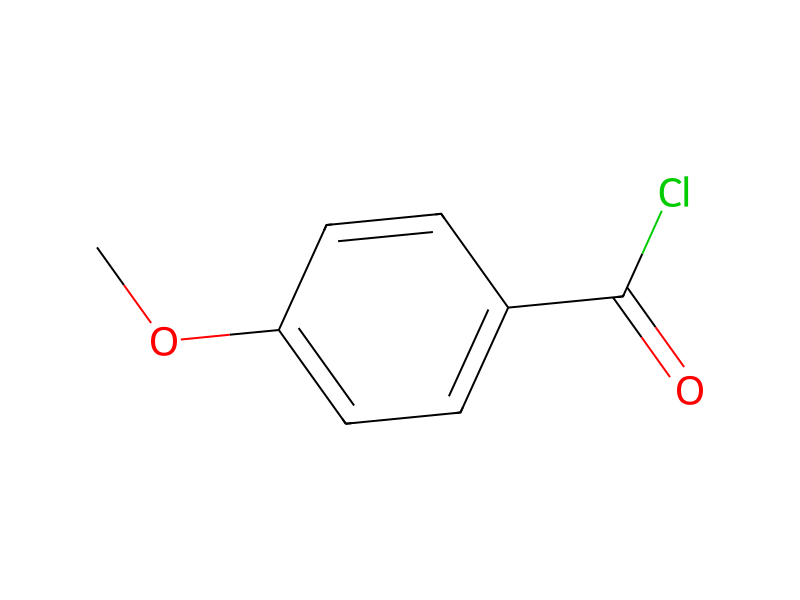
p-Anisoyl chloride → HCID 10808337, compound
Reaction equation

[CH2:1]([C:8]1[S:12][C:11]2[CH:13]=[CH:14][CH:15]=[CH:16][C:10]=2[CH:9]=1)[C:2]1[CH:7]=[CH:6][CH:5]=[CH:4][CH:3]=1.[C:17](Cl)(=[O:26])[C:18]1[CH:23]=[CH:22][C:21]([O:24][CH3:25])=[CH:20][CH:19]=1.[Sn](Cl)(Cl)(Cl)Cl>C(=S)=S>[CH2:1]([C:8]1[S:12][C:11]2[CH:13]=[CH:14][CH:15]=[CH:16][C:10]=2[C:9]=1[C:17]([C:18]1[CH:23]=[CH:22][C:21]([O:24][CH3:25])=[CH:20][CH:19]=1)=[O:26])[C:2]1[CH:3]=[CH:4][CH:5]=[CH:6][CH:7]=1Participants
5
Reactant 3


Product 1

Reagents, catalysts & solvents 1

Procedure
The known compound, 2-benzyl-benzo[b]thiophene (CA reg. no. 3407-15-6) was acylated with one equilvalent of anisoyl chloride using one equivalent of a tin (IV) chloride promoter in carbon disulfide solvent to afford (2-benzyl-benzo[b]thiophen-3-yl)-(4-methoxy-phenyl)-methanone (85% yield). This compound was demethylated using six equivalents of pyridinium hydrocholide at 228° C. to afford (2-benzyl-benzo[b]thiophen-3-yl)-(4-hydroxy-phenyl)-methanone (90% yield). This compound was brominated according to the procedure in Example 4 to afford the title compound as a white solid (95% yield): mp 155.5-156.5; ; MS m/e 500 (M)+ ; Analysis for: C22H14Br2O2S Calc'd: C, 52.61; H, 2.80 Found: C, 52.43; H, 2.71
Sources & evidence
- ORD record
- ord-9605fd8e4adf42a9b93cc2cc419f38ed
- Source dataset
- uspto-grants-2000_12
- Patent number
- US06166069
Reaction notes
Loading…