Sodium Sulfate → Sodium sulfate decahydrate
Reaction equation

[S:1]([O-:5])([O-:4])(=[O:3])=[O:2].[Na+:6].[Na+]>O>[OH2:2].[OH2:2].[OH2:2].[OH2:2].[OH2:2].[OH2:2].[OH2:2].[OH2:2].[OH2:2].[OH2:2].[S:1]([O-:5])([O-:4])(=[O:3])=[O:2].[Na+:6].[Na+:6]Participants
Reactant 1
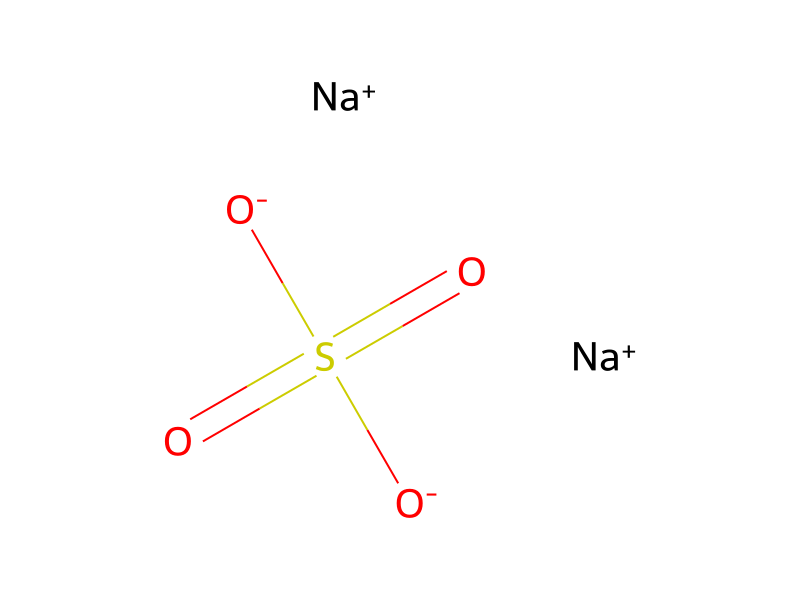
Product 1
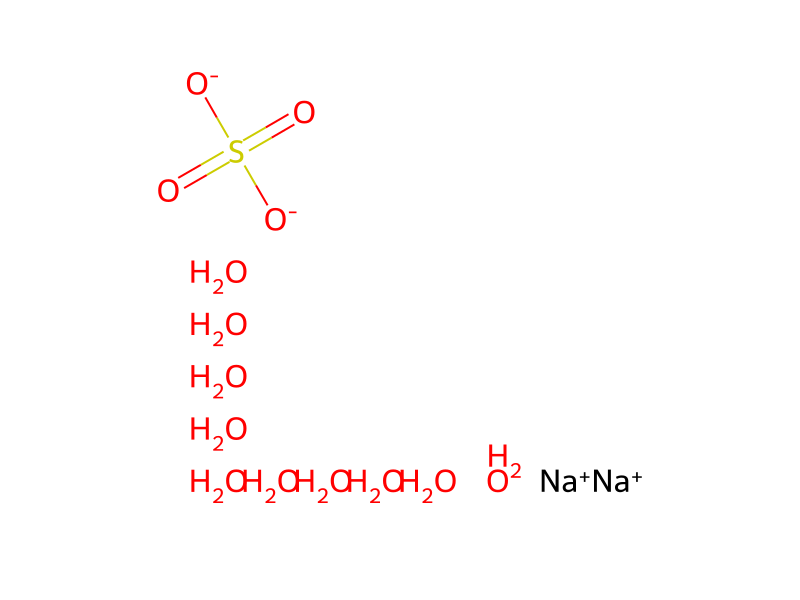
Reagents, catalysts & solvents 1

Procedure
30.8 parts of sodium sulfate was mixed with 39.2 parts of water with cooling to form 70 parts sodium sulfate decahydrate crystals. 23.4 parts of type II portland cement and 6.6 parts of water was added to the crystals with continued mixing to form a grainy thixotropic mass. This was then transferred into cylinders constructed of a laminate of polypropylene, aluminum foil, and polyester film. After 8 hours, the mixture had solidified sufficiently so that a hole could be produced in the mixture which was packed with a mixture of 50% borax and 50% sodium sulfate decahydrate after which the cylinders were hermetically sealed. After one weeks curing time these cylinders were cycled for over 1000 heat-cool cycles through the melting point of sodium sulfate decahydrate after which a calorimetric latent heat content determination revealed a latent heat storage content of 75.6 BTU's per pound (175.8 joules per gram).
Workup
- temperaturewith cooling
Sources & evidence
- ORD record
- ord-834a86608bf5408daca8644d821d471f
- Source dataset
- uspto-grants-1981_07
- Patent number
- US04277357
Reaction notes
Loading…