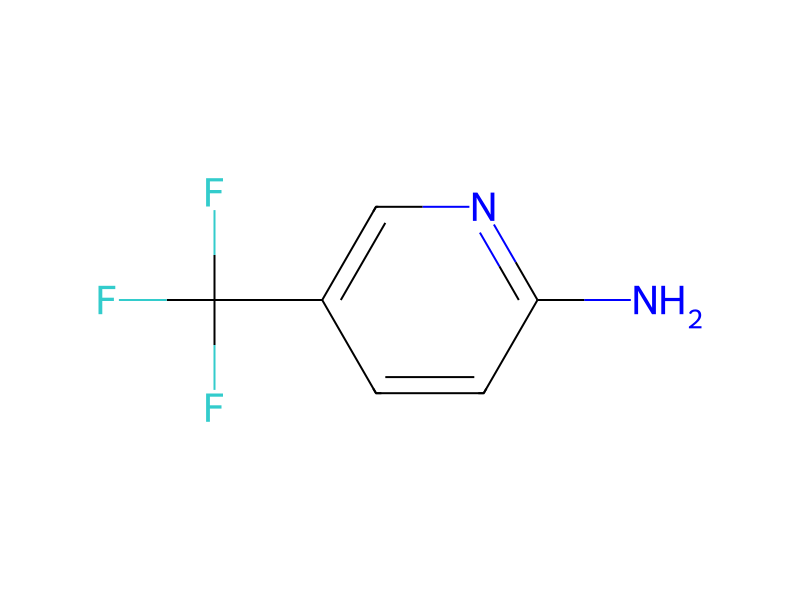
2-Amino-5-(trifluoromethyl)pyridine → 1-(2,6-Difluorobenzoyl)-3-(5-trifluoromethyl-2-pyridinyl)urea
Reaction equation

[F:1][C:2]([F:11])([F:10])[C:3]1[CH:4]=[CH:5][C:6]([NH2:9])=[N:7][CH:8]=1.[F:12][C:13]1[CH:23]=[CH:22][CH:21]=[C:20]([F:24])[C:14]=1[C:15]([N:17]=[C:18]=[O:19])=[O:16]>C(#N)C>[F:12][C:13]1[CH:23]=[CH:22][CH:21]=[C:20]([F:24])[C:14]=1[C:15]([NH:17][C:18]([NH:9][C:6]1[CH:5]=[CH:4][C:3]([C:2]([F:1])([F:10])[F:11])=[CH:8][N:7]=1)=[O:19])=[O:16]Participants
4
Reactant 2

Product 1

Reagents, catalysts & solvents 1

Procedure
An 0.7 g. portion of 5-trifluoromethyl-2-aminopyridine was dissolved in 20 ml. of acetonitrile, and to the solution was added 0.85 g. of 2,6-difluorobenzoyl isocyanate under a nitrogen blanket at ambient temperature. A precipitate formed immediately. The mixture was stirred for 3 hours, and was then filtered and the solids were washed with acetonitrile. The solids were dried under vacuum to obtain 1.0 g. of the product named above, m.p. 215°-220° C. Elemental analysis gave the following results:
Workup
- customat ambient temperature
- customA precipitate formed immediately
- filtrationwas then filtered
- washthe solids were washed with acetonitrile
- customThe solids were dried under vacuum
- customto obtain 1.0 g
- customElemental analysis gave the
- customfollowing results
Sources & evidence
- ORD record
- ord-fc3aa789986944659c9237b58e0cdf8d
- Source dataset
- uspto-grants-1981_07
- Patent number
- US04281003
Reaction notes
Loading…