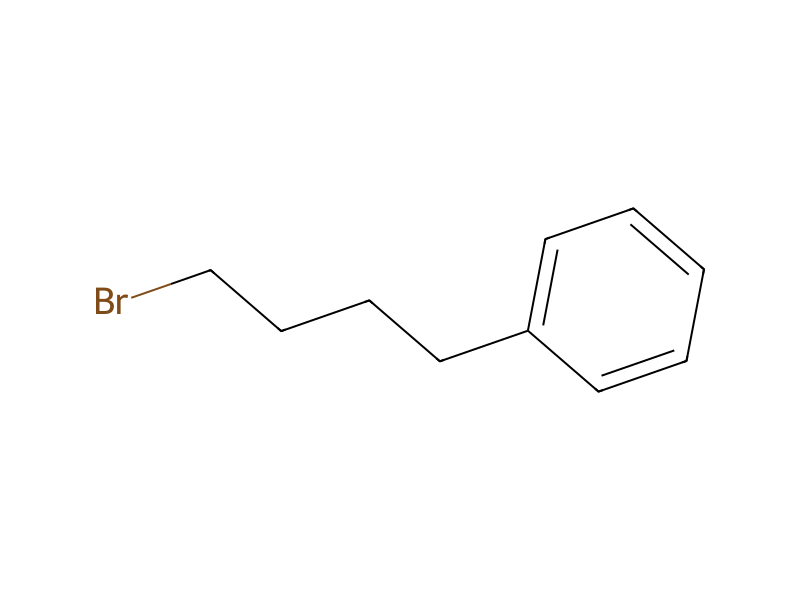
Triphenylphosphine → 1-Bromo-4-phenylbutane
Reaction equation

[C:1]1([CH2:7][CH2:8][CH2:9][CH2:10]O)[CH:6]=[CH:5][CH:4]=[CH:3][CH:2]=1.C1(P(C2C=CC=CC=2)C2C=CC=CC=2)C=CC=CC=1.C1C(=O)N([Br:38])C(=O)C1>C(Cl)Cl>[C:1]1([CH2:7][CH2:8][CH2:9][CH2:10][Br:38])[CH:6]=[CH:5][CH:4]=[CH:3][CH:2]=1Participants
5
Reactant 3



Product 1
Reagents, catalysts & solvents 1

Procedure
To a solution of 4-phenyl-1-butanol (5.00 g, 33.3 mmol) and CH2Cl2 (250 mL) at 0° C. was added triphenylphosphine (13.1 g, 50.0 mmol) followed by NBS (8.90 g, 50.0 mmol). After stirring at this temperature for 2 h, the mixture was quenched with H2O (50 mL) and extracted with CH2Cl2 (150 mL) The organic layer was washed with brine (40 mL) and dried (Na2SO4). After concentration, the residue was flushed through two quick columns of silica gel using 2% EtOAc/petroleum ether as an eluant to afford 4-phenylbutyl bromide (6.22 g, 88%) as an intermediate.
Workup
- customthe mixture was quenched with H2O (50 mL)
- extractionextracted with CH2Cl2 (150 mL) The organic layer
- washwas washed with brine (40 mL)
- dry with materialdried (Na2SO4)
- concentrationAfter concentration
- customthe residue was flushed through two quick columns of silica gel using 2% EtOAc/petroleum ether as an eluant
Sources & evidence
- ORD record
- ord-6fdba998d23444079e7382a38210f163
- Source dataset
- uspto-grants-2002_09
- Patent number
- US06451827B2
Reaction notes
Loading…