Participants
| Role | Name | HCID | Charge |
|---|
| Reactant | Imidazole | HCID 795 | — |
| Reactant | Methyl chloroformate | HCID 6586 | — |
| Reactant | Sodium hydride | HCID 24758 | — |
| Reactant | 2,4-Diamino-6-chloropyrimidine | HCID 67432 | — |
| Reactant | HCID 178418361 | HCID 178418361 | — |
| Solvent | Methanol | HCID 887 | — |
| Solvent | Dimethylformamide | HCID 6228 | — |
| Solvent | Tetrahydrofuran | HCID 8028 | — |
| Product | HCID 13424620 | HCID 13424620 | — |
Reaction Steps
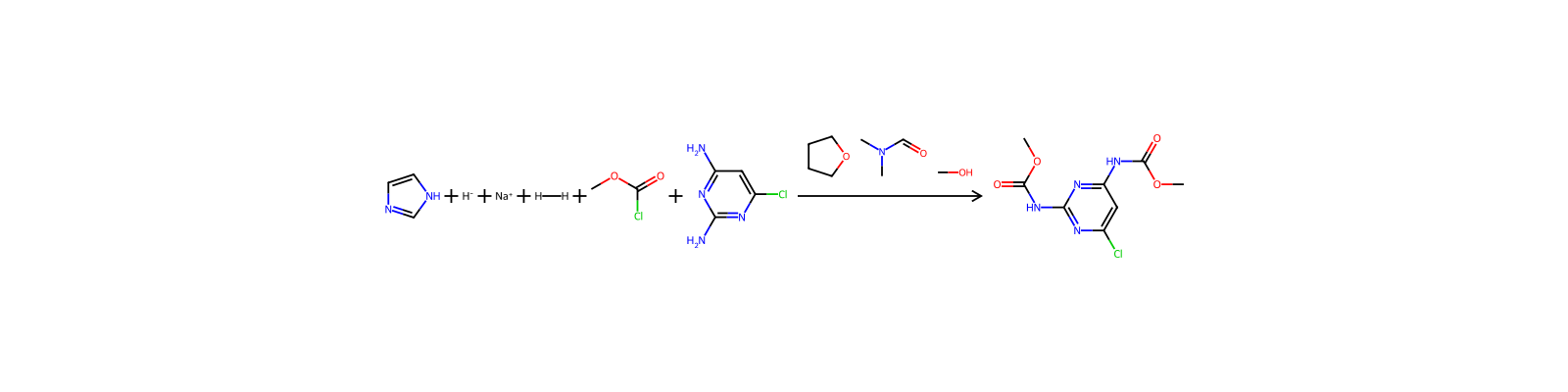
A solution of 2.7 g (0.041 mol) of imidazole in 50 ml of dry tetrahydrofuran is treated at 0° C. with 1.8 g (0.041 mol) of 55 to 60 percent sodium hydride. After the hydrogen formation has finished, 3.8 g (0.041 mol) of methyl chloroformate in 20 ml of dry tetrahydrofuran are added dropwise at 0° C., whereupon the suspension obtained is treated dropwise at 0° with a solution of 2.9 g (0.021 mol) of 6-chloro-2,4-diaminopyrimidine and 4.5 g (0.041 mol) of potassium t-butylate in 30 ml of dry dimethylformamide. The mixture is stirred at 0° for 1 hour and then at 50° for 3 hours, whereupon 3 ml of methanol are added thereto and the solvent is evaporated to the largest extent possible. The residue is poured into ice-cold water, adjusted with 1N hydrochloric acid to pH 2 and extracted with methylene chloride and a small amount of methanol. After drying the organic extract over magnesium sulphate and evaporation under vacuum, the residue is recrystallized from ethyl acetate, there being obtained pure dimethyl 6-chloro-2,4-pyrimidinedicarbamate.
Provenance & Evidence
| DOI | 10.6084/m9.figshare.5104873.v1 |
|---|
| Patent number | US04565869 |
|---|
| Source dataset | uspto-grants-1986_01 |
|---|
| ORD ID | ord-ca4b0dc123fb429f9e12919bbab8e6de |
|---|
| Source note | uspto-grants-1986_01 |
|---|