Ethanol → 6-Chloro-4-[[3-(dimethylamino)propyl]amino]-2-methyl-5-nitropyridine-3-carboxylic acid ethyl ester
Reaction equation

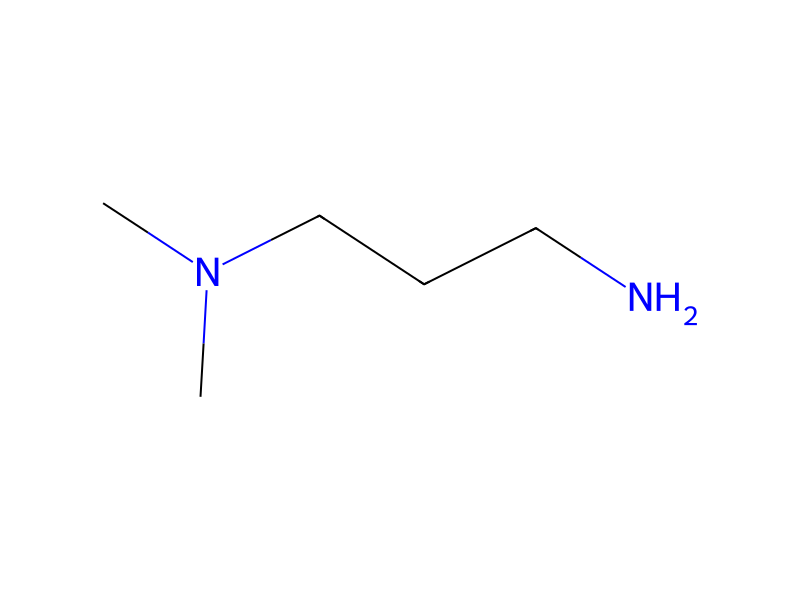
Cl[C:2]1[C:7]([N+:8]([O-:10])=[O:9])=[C:6]([Cl:11])[N:5]=[C:4]([CH3:12])[C:3]=1[C:13]([O:15][CH2:16][CH3:17])=[O:14].C(O)C.[CH3:21][N:22]([CH3:27])[CH2:23][CH2:24][CH2:25][NH2:26]>C(N(CC)CC)C>[Cl:11][C:6]1[N:5]=[C:4]([CH3:12])[C:3]([C:13]([O:15][CH2:16][CH3:17])=[O:14])=[C:2]([NH:26][CH2:25][CH2:24][CH2:23][N:22]([CH3:27])[CH3:21])[C:7]=1[N+:8]([O-:10])=[O:9]Participants
5
Reactant 3


Product 1

Reagents, catalysts & solvents 1

Procedure
139.5 g. of 4,6-dichloro-2-methyl-5-nitropyridine-3-carboxylic acid, ethyl ester (0.5 ml.) in 500 ml. of ethyl alcohol are heated at reflux temperature. 60 g. of triethylamine are added and then 51 g. of 3-(dimethylamino)propylamine are slowly dropped in with stirring. After the addition is completed, heating is continued for 10 minutes. The solvent is distilled off and the residue is treated with 200 ml. of water and made alkaline (pH 9-10) with sodium hydroxide. This mixture is extracted three times with 150 ml. portions of ether. The organic layers are combined, dried with calcium chloride and evaporated to dryness. The residue is recrystallized from methanol, yield 110 g. (64%); m.p. <20°.
Workup
- temperatureat reflux temperature
- additionAfter the addition
- temperatureheating
- distillationThe solvent is distilled off
- additionthe residue is treated with 200 ml
- extractionThis mixture is extracted three times with 150 ml
- dry with materialdried with calcium chloride
- customevaporated to dryness
- customThe residue is recrystallized from methanol, yield 110 g
Sources & evidence
- ORD record
- ord-95bd0e63b57443b39fe2509cbe3021e8
- Source dataset
- uspto-grants-1976_10
- Patent number
- US03984412
Reaction notes
Loading…