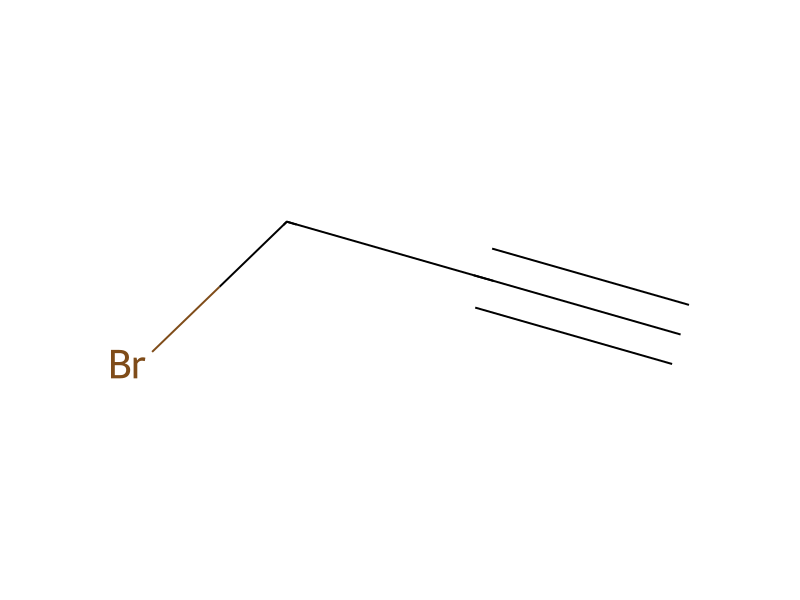
Propargyl bromide → 2-Methyl-2-propargyl-5-methoxy-6,7-dichloro-1-indanone
Reaction equation

[CH3:1][CH:2]1[CH2:10][C:9]2[C:4](=[C:5]([Cl:14])[C:6]([Cl:13])=[C:7]([O:11][CH3:12])[CH:8]=2)[C:3]1=[O:15].[H-].[Na+].[CH2:18](Br)[C:19]#[CH:20]>COCCOC>[CH3:1][C:2]1([CH2:20][C:19]#[CH:18])[CH2:10][C:9]2[C:4](=[C:5]([Cl:14])[C:6]([Cl:13])=[C:7]([O:11][CH3:12])[CH:8]=2)[C:3]1=[O:15]Participants
5




Procedure
2-Methyl-2-propargyl-5-methoxy-6,7-dichloro-1-indanone is prepared by following substantially the same procedure described in Example 4, Step B, using the following reagents: 2-methyl-5-methoxy-6,7-dichloro-1-indanone (14.7 g., 0.06 mole), sodium hydride (1.72 g., 0.072 mole), 1,2-dimethoxyethane (500 ml.) and propargyl bromide (8 ml.). The above procedure gives 16.5 g. (97%) of 2-methyl-2-propargyl-5-methoxy-6,7-dichloro-1-indanone which after recrystallization from methyl cyclohexane melts at 118°C.
Workup
- customThe above procedure gives 16.5 g
- custom(97%) of 2-methyl-2-propargyl-5-methoxy-6,7-dichloro-1-indanone which after recrystallization from methyl cyclohexane melts at 118°C.
Sources & evidence
- ORD record
- ord-8834a15e218a4e789204cf4b6cec534e
- Source dataset
- uspto-grants-1976_10
- Patent number
- US03984465
Reaction notes
Loading…