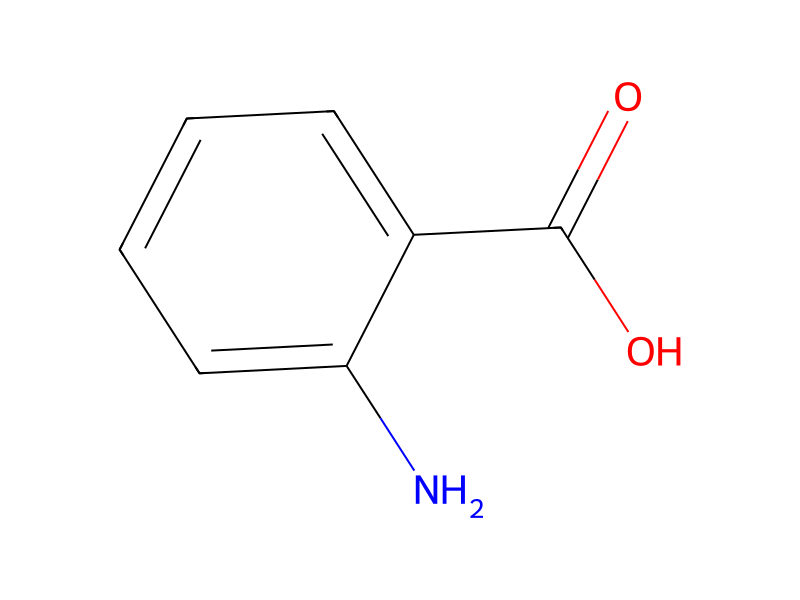
Anthranilic Acid → HCID 20315068, compound
Reaction equation

[C:1]([OH:10])(=[O:9])[C:2]1[C:3](=[CH:5][CH:6]=[CH:7][CH:8]=1)N.[ClH:11].N([O-])=O.[Na+].[C:16](#[N:19])[CH:17]=[CH2:18]>[Cl-].[Na+].O.CC(C)=O.C(O)(=O)C>[Cl:11][CH:17]([C:16]#[N:19])[CH2:18][C:3]1[CH:5]=[CH:6][CH:7]=[CH:8][C:2]=1[C:1]([OH:10])=[O:9]Participants







Procedure
274 parts of anthranilic acid are mixed with 650 parts of hydrochloric acid (density 1.15) and 560 parts of crystallizable acetic acid. The mixture is cooled externally to 0° C. by means of a brine, then diazotised by means of 138 parts of sodium nitrite. The solution of the diazo derivative is then poured, whilst being stirred, into a mixture of 190 parts of acetone and 370 parts of acrylonitrile, at the same time as a solution of 6 parts of cuprous chloride in 50 parts of hydrochloric acid (density 1.08). The reaction is exothermic. After the diazonium chloride has disappeared and after decantation and crystallization in water, 330 parts of a product are obtained which has a melting point of 116°-117° C. and which is recrystallized in xylene. 314 parts of 2-(2-chloro-2-cyanoethyl) benzoic acid are obtained. M.P.: 119°-120° C.
Workup
- customafter decantation and crystallization in water
- custom330 parts of a product are obtained which
- customis recrystallized in xylene
Sources & evidence
- ORD record
- ord-9c35e1e7a2fa45079fad4a576af1933b
- Source dataset
- uspto-grants-1976_10
- Patent number
- US03987027
Reaction notes
Loading…