p-Bromochlorobenzene → 4-Chlorophenyltrichlorosilane
Reaction equation

Br[C:2]1[CH:7]=[CH:6][C:5]([Cl:8])=[CH:4][CH:3]=1.[Mg].[Si:10]([Cl:14])([Cl:13])([Cl:12])[Cl:11]>C(OCC)C>[Cl:8][C:5]1[CH:6]=[CH:7][C:2]([Si:10]([Cl:13])([Cl:12])[Cl:11])=[CH:3][CH:4]=1.[Cl:8][C:5]1[CH:6]=[CH:7][C:2]([Si:10]([C:2]2[CH:7]=[CH:6][C:5]([Cl:8])=[CH:4][CH:3]=2)([Cl:14])[Cl:11])=[CH:3][CH:4]=1Participants
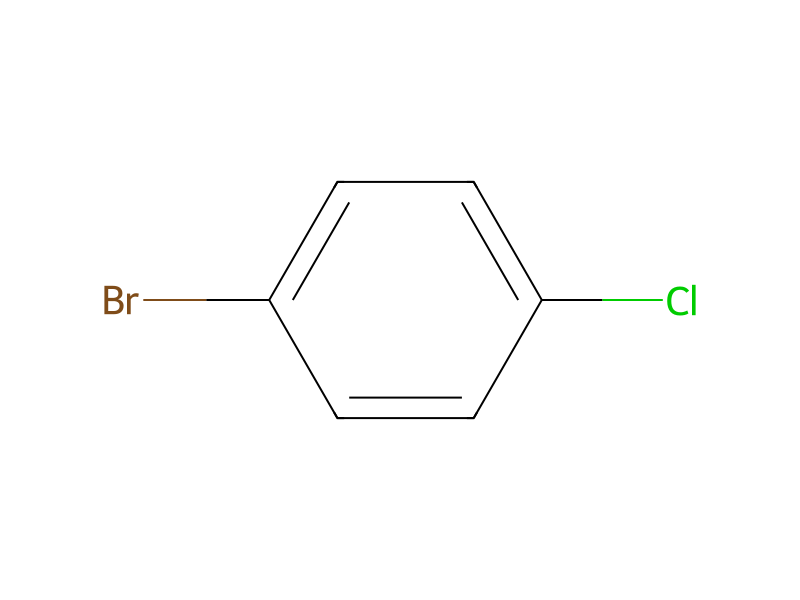





Procedure
The Grignard reagent solution prepared, under nitrogen, from 1-bromo-4-chlorobenzene (38.3 g, 0.2 mol) and magnesium (4.867 g, 0.2 g atom) in 300 ml anhydrous diethyl ether, is filtered through a glass filter-stick by nitrogen pressure into a graduated feed-funnel, from which it is fed during 21/4 hours into a stirred solution of redistilled silicon tetrachloride (102 g, 0.6 mol) in 200 ml of dry ether. The solution is heated at reflux temperature an additional 2 hours, then cooled and filtered under nitrogen. If not protected from the air, the solution turns red and reduced yields are obtained. The ether and excess silicon chloride is concentrated in vacuum and the residue distilled in vacuum under nitrogen. 4-Chlorophenyl trichlorosilane (17 g, 35 percent yield), b.p. 84°-85° C/3.4 mm, nD27.5 1.5400, and bis(4-chlorophenyl) dichlorosilane (6.2 g, 20 percent yield), b.p. 146°-150° C/0.4 mm, m.p. 60°-61° C are obtained.
Workup
- filtrationis filtered through a glass
- filtrationfilter-stick by nitrogen pressure into a graduated feed-funnel, from which it
- custom4 hours
- temperatureThe solution is heated
- temperatureat reflux temperature an additional 2 hours
- temperaturecooled
- filtrationfiltered under nitrogen
- customreduced yields
- customare obtained
- concentrationThe ether and excess silicon chloride is concentrated in vacuum
- distillationthe residue distilled in vacuum under nitrogen
Sources & evidence
- ORD record
- ord-92cdc9405e3d4d83929cd16ed7068f5b
- Source dataset
- uspto-grants-1976_10
- Patent number
- US03987009
Reaction notes
Loading…