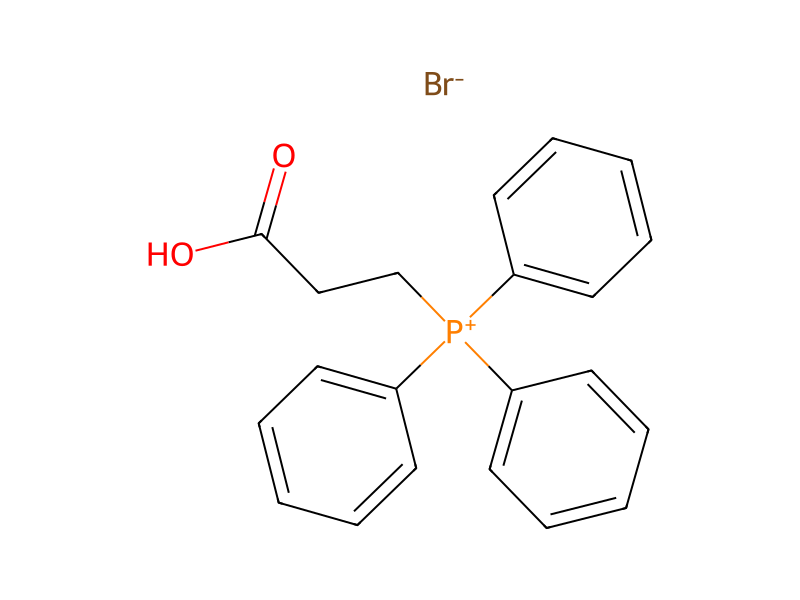
3-Bromopropionic acid → (2-Carboxyethyl)triphenylphosphonium bromide
Reaction equation

[Br:1][CH2:2][CH2:3][C:4]([OH:6])=[O:5].[C:7]1([P:13]([C:20]2[CH:25]=[CH:24][CH:23]=[CH:22][CH:21]=2)[C:14]2[CH:19]=[CH:18][CH:17]=[CH:16][CH:15]=2)[CH:12]=[CH:11][CH:10]=[CH:9][CH:8]=1>C(#N)C>[Br-:1].[C:4]([CH2:3][CH2:2][P+:13]([C:14]1[CH:15]=[CH:16][CH:17]=[CH:18][CH:19]=1)([C:20]1[CH:25]=[CH:24][CH:23]=[CH:22][CH:21]=1)[C:7]1[CH:8]=[CH:9][CH:10]=[CH:11][CH:12]=1)([OH:6])=[O:5]Participants
4
Reactant 2


Product 1
Reagents, catalysts & solvents 1

Procedure
A mixture of 3-bromopropionic acid (50 g.), triphenylphosphine (85.8 g.) and acetonitrile (250 ml.) is heated under reflux for 23 hrs. and then 166 ml. of acetonitrile is removed by distillation. After cooling the remaining solution to room temperature, benzene (250 ml.) is added and the mixture is allowed to stand for 16 hrs. The solid which separates is removed by filtration to give 120.5 g. of the title compound, m.p. 197°-200°; infrared absorptions at 2900, 2610, 2540, 1745, 1620, 1585, 1485, 1435, 1385, 1325, 1230, 1110, 750, 725 and 690 cm-1 ; NMR peaks at 2.7-3.3 (broad), 3.5-4.2 (broad) and 7.6-7.9 (multiplet) δ.
Workup
- temperatureis heated
- temperatureunder reflux for 23 hrs
- customof acetonitrile is removed by distillation
- additionbenzene (250 ml.) is added
- customThe solid which separates is removed by filtration
- customto give 120.5 g
Sources & evidence
- ORD record
- ord-6d65f9d2dc874d36a3b936f67021e4bc
- Source dataset
- uspto-grants-1976_10
- Patent number
- US03987087
Reaction notes
Loading…