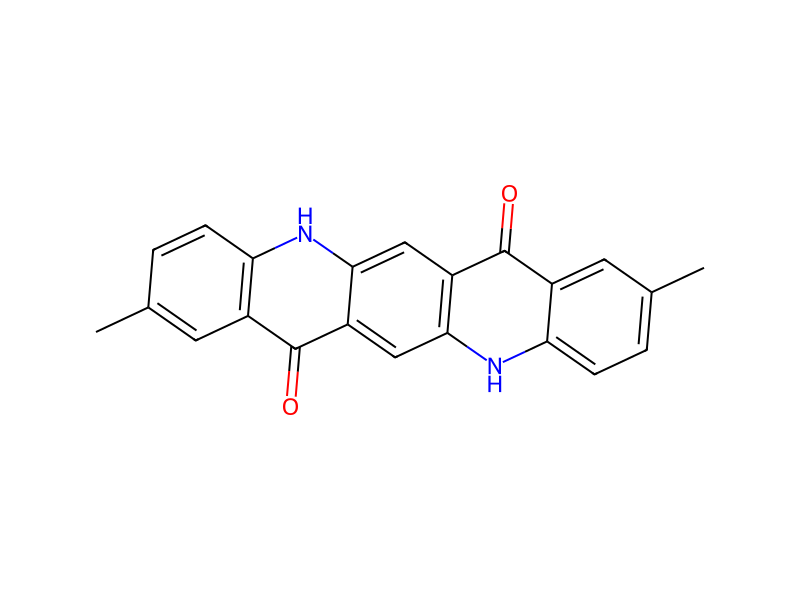
2,5-Di-p-toluidinoterephthalic acid → 5,12-Dihydro-2,9-dimethylquino(2,3-b)acridine-7,14-dione
Reaction equation

[CH3:1][C:2]1[CH:28]=[CH:27][C:5]([NH:6][C:7]2[CH:15]=[C:14]([C:16]([OH:18])=O)[C:13]([NH:19][C:20]3[CH:25]=[CH:24][C:23]([CH3:26])=[CH:22][CH:21]=3)=[CH:12][C:8]=2[C:9](O)=[O:10])=[CH:4][CH:3]=1.S(N(C1C=C(C(O)=O)C(N(S(=O)(=O)N)C2C=CC=CC=2)=CC=1C(O)=O)C1C=CC=CC=1)(=O)(=O)N>>[CH3:1][C:2]1[CH:28]=[CH:27][C:5]2[NH:6][C:7]3[C:8]([C:9](=[O:10])[C:4]=2[CH:3]=1)=[CH:12][C:13]1[NH:19][C:20]2[CH:25]=[CH:24][C:23]([CH3:26])=[CH:22][C:21]=2[C:16](=[O:18])[C:14]=1[CH:15]=3Participants
3


Procedure
Pigmentary 2,9-dimethylquinacridone was prepared exactly as described in comparison Example 1 except that 2% by weight, relative to the 2,5-di(4-methylanilino)terephthalic acid, of 2,5-di(sulfamoylanilino)terephthalic acid (1.4 g) was included in the ring-closure reaction. 2,9-Dimethylquinacridone (58 g) was obtained as a magenta pigment.
Workup
- customPigmentary 2,9-dimethylquinacridone was prepared exactly
- customwas included in the ring-closure reaction
Sources & evidence
- ORD record
- ord-5914920594b844428b1518607bc0b0bc
- Source dataset
- uspto-grants-1998_05
- Patent number
- US05755873
Reaction notes
Loading…