4-Nitrobenzenesulfonyl chloride → HCID 54556373, compound
Reaction equation

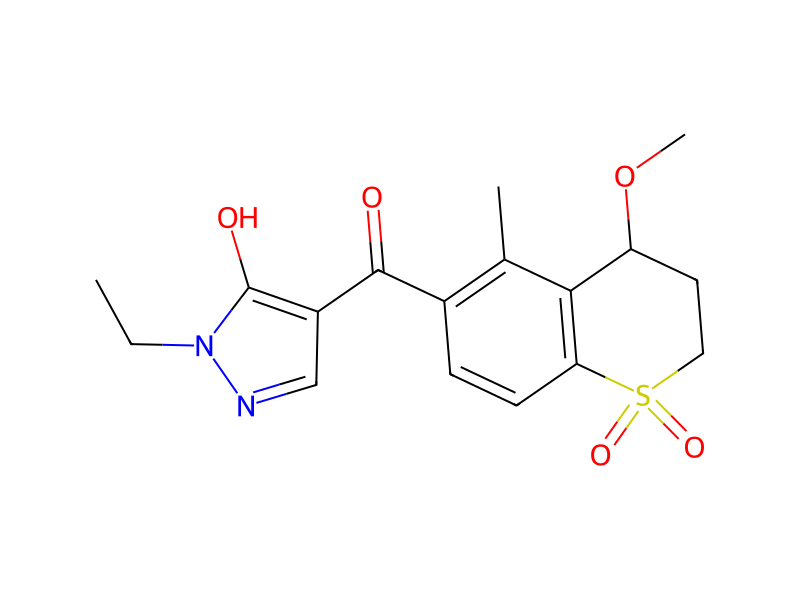
[CH3:1][O:2][CH:3]1[C:12]2[C:7](=[CH:8][CH:9]=[C:10]([C:14]([C:16]3[CH:17]=[N:18][N:19]([CH2:22][CH3:23])[C:20]=3[OH:21])=[O:15])[C:11]=2[CH3:13])[S:6](=[O:25])(=[O:24])[CH2:5][CH2:4]1.C(=O)([O-])[O-].[K+].[K+].[N+:32]([C:35]1[CH:40]=[CH:39][C:38]([S:41](Cl)(=[O:43])=[O:42])=[CH:37][CH:36]=1)([O-:34])=[O:33].[Cl-].ClCC[N+](CC1C=CC=CC=1)(CC)CC>C(Cl)Cl.O>[CH3:1][O:2][CH:3]1[C:12]2[C:7](=[CH:8][CH:9]=[C:10]([C:14]([C:16]3[CH:17]=[N:18][N:19]([CH2:22][CH3:23])[C:20]=3[O:21][S:41]([C:38]3[CH:37]=[CH:36][C:35]([N+:32]([O-:34])=[O:33])=[CH:40][CH:39]=3)(=[O:42])=[O:43])=[O:15])[C:11]=2[CH3:13])[S:6](=[O:24])(=[O:25])[CH2:5][CH2:4]1Participants






Procedure
4-Methoxy-5-methyl-6-(1-ethyl-5-hydroxypyrazol-4-yl) carbonylthiochroman-1,1-dioxide was used as a starting material (XIH). And, 0.4 g (1.10 mmol) thereof was dissolved in 6 ml of methylene chloride, a solution of 0.30 g (2.20 mmol) of potassium carbonate as a base in 4 ml of water was added, and 0.29 g (1.30 mmol) of p-nitrobenzenesulfonyl chloride and 0.05 g (0.2 mmol) of chlorobenzyltriethylammonium chloride as reaction reagents (XII) were added. The resultant mixture was allowed to react at room temperature for 2 hours. Further, the reaction mixture was refluxed under heat for 2 hours. After the reaction mixture was allowed to cool, its methylene chloride layer was separated, and dried over anhydrous sodium sulfate. Then, the solvent was distilled off under reduced pressure, and the resultant oil was purified with flush column chromatography to give 0.42 g (yield 70%) of 4-methoxy-5-methyl-6-(1-ethyl-5-(p-nitrobenzenesulfonyl) oxypyrazol-4-yl)carbonylthiochroman-1,1-dioxide (Compound No. 13) as an end compound which comes under the general formula (XI). Table 22 shows the structures of the starting material (XIH) and the reaction reagent (XII), and the structure and the yield of the end product (XI).
Workup
- additionwere added
- customto react at room temperature for 2 hours
- temperatureFurther, the reaction mixture was refluxed
- temperatureunder heat for 2 hours
- temperatureto cool
- customits methylene chloride layer was separated
- dry with materialdried over anhydrous sodium sulfate
- distillationThen, the solvent was distilled off under reduced pressure
- customthe resultant oil was purified
- customwith flush column chromatography
Sources & evidence
- ORD record
- ord-f466f0ba3e8f4966a881aa268c7a4419
- Source dataset
- uspto-grants-1998_05
- Patent number
- US05756759
Reaction notes
Loading…