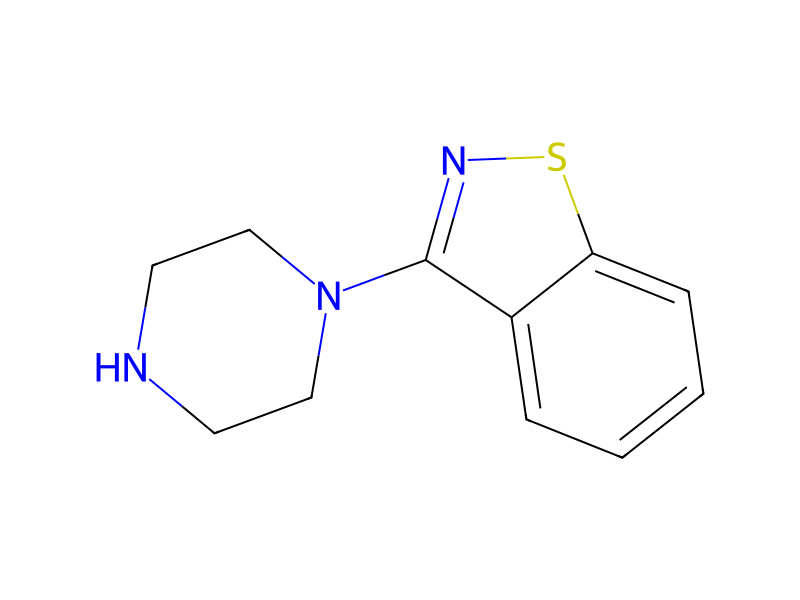
Piperazine → 3-(1-Piperazinyl)-1,2-benzisothiazole
Reaction equation

[NH:1]1[CH2:6][CH2:5][NH:4][CH2:3][CH2:2]1.[C:7]([C:9]1[CH:14]=[CH:13][CH:12]=[CH:11][C:10]=1[S:15]Cl)#[N:8]>ClC1C=CC=CC=1>[N:1]1([C:7]2[C:9]3[CH:14]=[CH:13][CH:12]=[CH:11][C:10]=3[S:15][N:8]=2)[CH2:6][CH2:5][NH:4][CH2:3][CH2:2]1Participants
4
Reactant 2


Product 1
Reagents, catalysts & solvents 1

Conditions
- Temperature
- 130 °C
Procedure
86.2 g (1.00 mol) of piperazine and 7.5 g of chlorobenzene were placed in a 500 ml four-neck flask equipped with a stirrer, a thermometer, a dropping funnel and a condenser and 42.4 g (0.25 mol) of molten 2-cyanobenzenesulfenyl chloride was added dropwise thereto at about 130° C. over one hour while stirring, followed by stirring for four hours to complete the reaction. The excess piperazine was removed with water, followed by acidification with hydrochloric acid and extraction into the aqueous layer. The aqueous layer was basified with an aqueous sodium hydroxide solution to obtain 40.9 g (m.p.: 89°-90° C.) of 3-(1-piperazinyl)-1,2-benzisothiazole as crystals. The yield starting from 2-cyanobenzenesulfenyl chloride was 74.7%.
Workup
- customequipped with a stirrer
- stirringby stirring for four hours
- customthe reaction
- customThe excess piperazine was removed with water
- extractionfollowed by acidification with hydrochloric acid and extraction into the aqueous layer
Sources & evidence
- ORD record
- ord-32d19eed9477431cb56605f74b940ba2
- Source dataset
- uspto-grants-1998_05
- Patent number
- US05756806
Reaction notes
Loading…