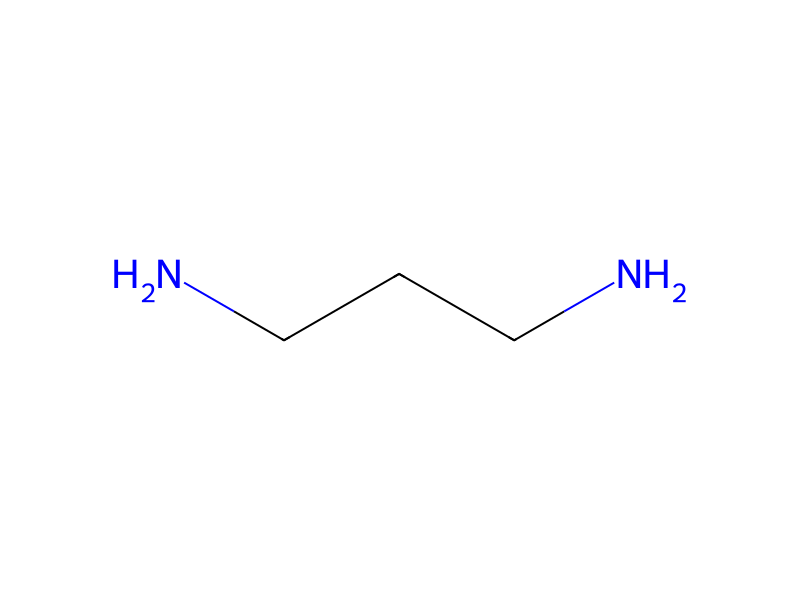
1,3-Propanediamine → (1R,2S)-2-methoxycyclohexanol
Reaction equation

[OH-].[K+].C(N)CCN.[CH3:8][O:9][CH:10]1[CH2:15][CH2:14][CH2:13][CH2:12][C:11]1=[O:16].[H][H]>CC(O)C>[CH3:8][O:9][C@H:10]1[CH2:15][CH2:14][CH2:13][CH2:12][C@H:11]1[OH:16]Participants
Reactant 4



Product 1

Reagents, catalysts & solvents 1

Procedure
In a 100 ml autoclave were charged 1.75 ml of a 0.2M solution of potassium hydroxide (0.35 mmol) in 2-propanol, 0.2 ml of a 0.1M solution of 1,3-propanediamine (0.02 mmol) in 2-propanol, 1.28 g (10.0 mmol) of 2-methoxycyclohexanone, 8.4 mg (0.005 mmol) of Ru2Cl4 [(S)-BINAP]2NEt3, and 8 ml of 2-propanol in a nitrogen atmosphere, and hydrogen was introduced therein to 50 atm. The mixture was stirred at room temperature for 1.5 hours. The disappearance of the starting material was confirmed by gas chromatography. The solvent was evaporated under reduced pressure, and the residue was distilled under reduced pressure to obtain (1R,2S)-2-methoxycyclohexanol. The optical purity of the product was found to be 93% d.e. and 91% e.e. by gas chromatography.
Workup
- additionwas introduced
- customThe solvent was evaporated under reduced pressure
- distillationthe residue was distilled under reduced pressure
Sources & evidence
- ORD record
- ord-0b4f1140817249edb40c92c31b7ef285
- Source dataset
- uspto-grants-1998_05
- Patent number
- US05756863
Reaction notes
Loading…