Piperazine → 6-Chloro-1-cyclopropyl-8-fluoro-1,4-dihydro-4-oxo-7-(1-piperazinyl)-3-quinolinecarboxylic acid
Reaction equation
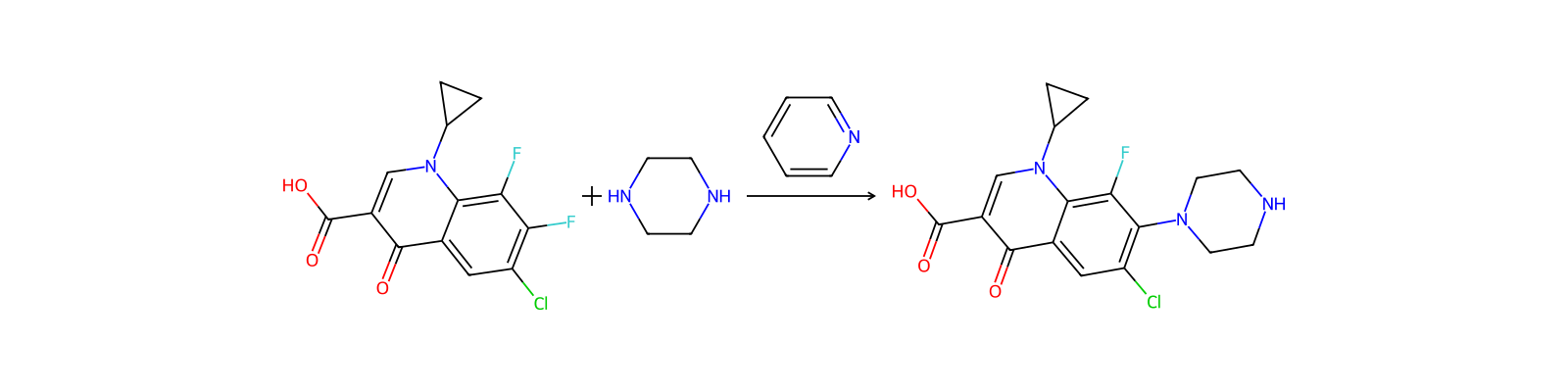
[Cl:1][C:2]1[CH:3]=[C:4]2[C:9](=[C:10]([F:13])[C:11]=1F)[N:8]([CH:14]1[CH2:16][CH2:15]1)[CH:7]=[C:6]([C:17]([OH:19])=[O:18])[C:5]2=[O:20].[NH:21]1[CH2:26][CH2:25][NH:24][CH2:23][CH2:22]1>N1C=CC=CC=1>[Cl:1][C:2]1[CH:3]=[C:4]2[C:9](=[C:10]([F:13])[C:11]=1[N:21]1[CH2:26][CH2:25][NH:24][CH2:23][CH2:22]1)[N:8]([CH:14]1[CH2:16][CH2:15]1)[CH:7]=[C:6]([C:17]([OH:19])=[O:18])[C:5]2=[O:20]Participants
4
Reactant 2


Product 1

Reagents, catalysts & solvents 1

Procedure
12 g (40 mmol) of the product from Example A in 100 ml of pyridine are heated with 17.2 g (0.2 mole) of piperazine under reflux for 5 hours. The mixture i s concentrated in vacuo, the residue is stirred with 120 ml of water and the pH is adjusted to 5 with 2N hydrochloric acid. The precipitate is filtered off with suction, washed with water and methanol, boiled in 80 ml of methanol and dried. 12.3 g (84% of theory) 6-chloro-1-cyclopropyl-8-fluoro-1,4-dihydro-4-oxo-7-(1-piperazinyl)-3-quinolinecarboxylic acid of melting point 295°-298° (with decomposition) are obtained.
Workup
- temperatureunder reflux for 5 hours
- concentrationThe mixture i s concentrated in vacuo
- filtrationThe precipitate is filtered off with suction
- washwashed with water and methanol
- customdried
Sources & evidence
- ORD record
- ord-60fef72bca1942cd9056f643f7136d4c
- Source dataset
- uspto-grants-1995_11
- Patent number
- US05468861
Reaction notes
Loading…