1-Propylboronic acid → HCID 68688475, compound
Reaction equation

Cl[C:2]1[CH:11]=[CH:10][C:9]2[C:8](=[O:12])[N:7]3[CH2:13][CH2:14][NH:15][CH2:16][C@H:6]3[CH2:5][C:4]=2[CH:3]=1.[CH2:17](B(O)O)[CH2:18][CH3:19].[F-].[K+]>O1CCOCC1.[Pd].C(P(C(C)(C)C)C(C)(C)C)(C)(C)C.C(P(C(C)(C)C)C(C)(C)C)(C)(C)C>[CH2:19]([N:15]1[CH2:14][CH2:13][N:7]2[C:8](=[O:12])[C:9]3[CH:10]=[CH:11][C:2]([CH2:5][CH2:6][CH3:16])=[CH:3][C:4]=3[CH2:5][C@@H:6]2[CH2:16]1)[C:18]1[CH:17]=[CH:4][CH:3]=[CH:2][CH:11]=1Participants
6





Conditions
- Temperature
- 100 °C
Procedure
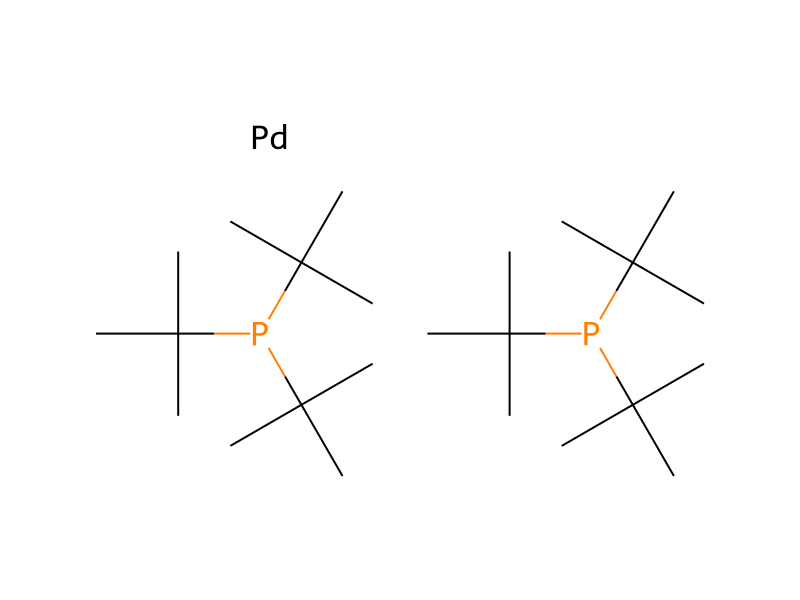
A mixture of (R)-9-chloro-1,2,3,4,11,11a-hexahydro-pyrazino[1,2-b]isoquinolin-6-one (50 mg, 0.15 mmol), bis(tri-t-butyl phosphine) palladium (2.3 mg, 0.0045 mmol), propyl boronic acid (16 mg, 0.18 mmol), and potassium fluoride(19 mg, 0.33 mmol) in anhydrous 1,4-dioxane (2 mL) was degassed, heated to 100° C. and stirred for 6 h under nitrogen atomsphare. Then the mixture was cooled down to room temperature, diluted with 10 ml of EtOAc and filtered through celite pad. The filtrate was concentrated to give the desired product which was used for next step without further purification. MS (ESI) 335 (M+H).
Workup
- customwas degassed
- temperatureThen the mixture was cooled down to room temperature
- additiondiluted with 10 ml of EtOAc
- filtrationfiltered through celite pad
- concentrationThe filtrate was concentrated
Sources & evidence
- ORD record
- ord-6b830940b8da4a19bc38cc9cf580959b
- Source dataset
- uspto-grants-2007_07
- Patent number
- US07244843B2
Reaction notes
Loading…