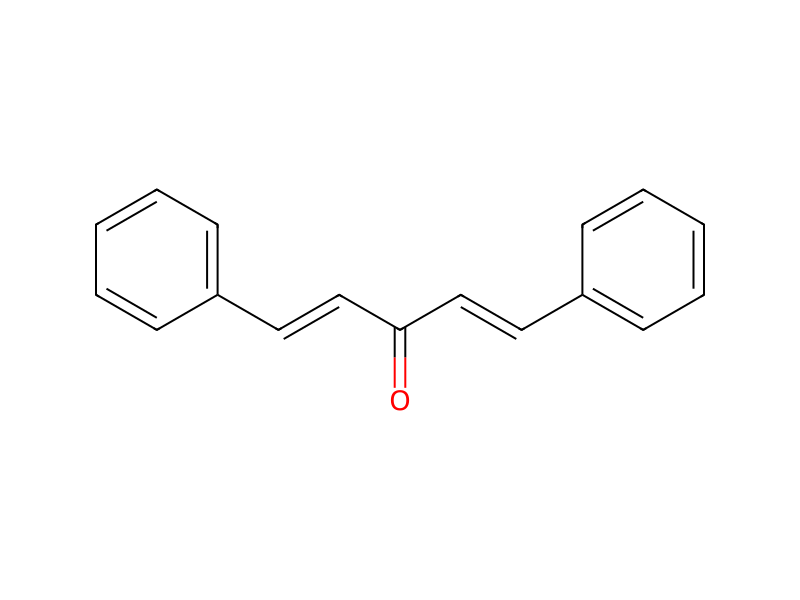
Acetone → Dibenzylidene acetone
Reaction equation

[OH-].[Na+].[CH2:3]([OH:5])[CH3:4].[CH:6](=O)[C:7]1[CH:12]=[CH:11][CH:10]=[CH:9][CH:8]=1.[CH3:14][C:15]([CH3:17])=O>>[CH:6](=[CH:4][C:3]([CH:14]=[CH:15][C:17]1[CH:11]=[CH:12][CH:7]=[CH:8][CH:9]=1)=[O:5])[C:7]1[CH:12]=[CH:11][CH:10]=[CH:9][CH:8]=1Participants




Procedure
To an aqueous solution of sodium hydroxide (200 grams (g) in one liter of water) was added ethanol (1.6 liters; purity greater than 95%) and the resultant mixture was stirred well. Another mixture having acetone (29 g) and benzaldehyde (106 g) was added to this solution under stirring. A yellow colored precipitate was observed. The stirring was continued for about 15 minutes (min). Subsequently additional acetone (29 g) and benzaldehyde (106 g) were added and the mixture was stirred for another 45 min. The yellow colored precipitate was separated by filtration, washed with water (2 liters), and dried at room temperature to get 223 g of crude dibenzalacetone. Melting point of the compound was obtained as 104-106° C. This product was used in the next step without further purification.
Workup
- additionwas added to this solution
- stirringthe mixture was stirred for another 45 min
- customThe yellow colored precipitate was separated by filtration
- washwashed with water (2 liters)
- customdried at room temperature
Sources & evidence
- ORD record
- ord-98bf2159bdca4496b99a0f51b7b05868
- Source dataset
- uspto-grants-2008_06
- Patent number
- US07381786B2
Reaction notes
Loading…