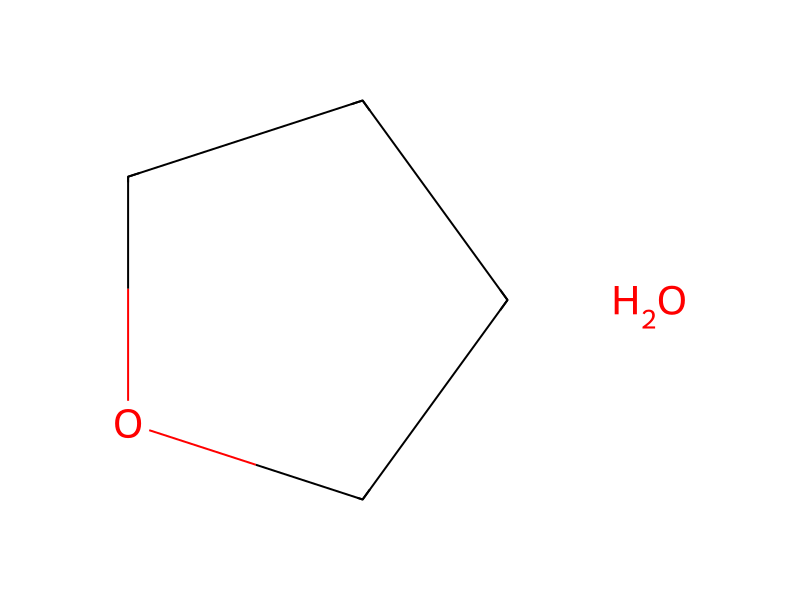
Lithium hydroxide, monohydrate → HCID 178524946, compound
Reaction equation

C([O:3][C:4]([C:6]1[C:10]([C:11]2[CH:16]=[CH:15][C:14]([Cl:17])=[CH:13][C:12]=2[Cl:18])=[CH:9][NH:8][N:7]=1)=[O:5])C.O.[OH-].[Li+]>C1COCC1.O>[Cl:18][C:12]1[CH:13]=[C:14]([Cl:17])[CH:15]=[CH:16][C:11]=1[C:10]1[C:6]([C:4]([OH:5])=[O:3])=[N:7][NH:8][CH:9]=1Participants
4
Reactant 2


Product 1

Reagents, catalysts & solvents 1
Procedure
A solution of 4-(2,4-dichloro-phenyl)-1H-pyrazole-3-carboxylic acid ethyl ester (205 mg; 0.72 mmol) and lithium hydroxide monohydrate (125 mg; 2.9 mmol) in 1:1 THF/water (10 ml) was heated at 60° C. overnight. The THF was removed by evaporation, the aqueous phase acidified with 1 M hydrochloric acid then extracted with ethyl acetate (20 ml). The ethyl acetate layer was dried (MgSO4), filtered and evaporated to give 200 mg of 4-(2,4-dichloro-phenyl)-1H-pyrazole-3-carboxylic acid. (LC/MS: [M+H]+256.85).
Workup
- customThe THF was removed by evaporation
- extractionthen extracted with ethyl acetate (20 ml)
- dry with materialThe ethyl acetate layer was dried (MgSO4)
- filtrationfiltered
- customevaporated
Sources & evidence
- ORD record
- ord-8e8ff05648014ac99c5312a006cb221f
- Source dataset
- uspto-grants-2008_06
- Patent number
- US07385059B2
Reaction notes
Loading…