Isopropanol → HCID 21094261, compound
Reaction equation

[ClH:1].Cl.Cl.N[C:5]1[CH:6]=[C:7]([CH:11]2[CH2:16][CH:15]3[CH2:17][CH2:18][N:12]2[CH2:13][CH2:14]3)[CH:8]=[N:9][CH:10]=1.N(OCCC(C)C)=O.C(Cl)(Cl)[Cl:28].[CH:31]([OH:34])([CH3:33])[CH3:32]>>[ClH:28].[ClH:1].[CH:31]([O:34][C:5]1[CH:6]=[C:7]([CH:11]2[CH2:16][CH:15]3[CH2:17][CH2:18][N:12]2[CH2:13][CH2:14]3)[CH:8]=[N:9][CH:10]=1)([CH3:33])[CH3:32]Participants




Procedure
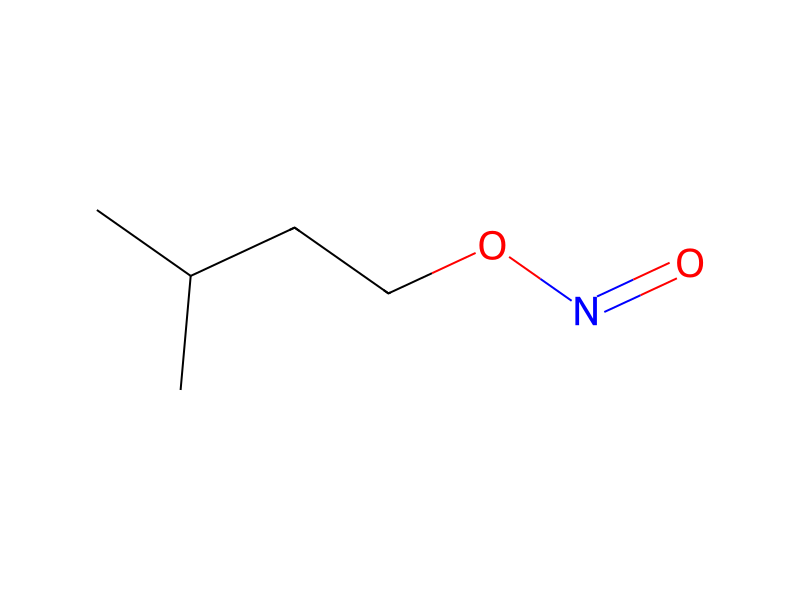
To a stirred solution of 2-(5-amino-3-pyridyl)-1-azabicyclo[2.2.2]octane trihydrochloride (50 mg, 0.16 mmol) in dry isopropanol (5 mL) was added isoamyl nitrite (0.1 mL, 0.97 mmol) and the reaction mixture was refluxed for 2 h. When TLC analysis of the reaction mixture showed the absence of starting material, the mixture was allowed to warm to ambient temperature and then the solvent was removed under vacuum. A white solid was obtained upon the addition of dry diethyl ether. The solid was dissolved with heating in a minimum amount of chloroform, and the solution kept over night at 4° C. to induce crystallization. The solid thus obtained was filtered and dried under vacuum for 24 h to afford 2-(5-isopropoxy-3-pyridyl)-1-azabicyclo[2.2.2]octane dihydrochloride (28 mg, 55%) as colorless needles.
Workup
- temperaturethe reaction mixture was refluxed for 2 h
- customthe solvent was removed under vacuum
- customA white solid was obtained upon the addition of dry diethyl ether
- dissolutionThe solid was dissolved
- waitthe solution kept over night at 4° C.
- customcrystallization
- customThe solid thus obtained
- filtrationwas filtered
- customdried under vacuum for 24 h
Sources & evidence
- ORD record
- ord-a20734fb194e4f9eaa6a117c59859d07
- Source dataset
- uspto-grants-2007_05
- Patent number
- US07214686B2
Reaction notes
Loading…