Pyridine → HCID 23077305, compound
Reaction equation

N1C=CC=CC=1.[F:7][C:8]1[C:17]2[C:12](=[CH:13][CH:14]=[C:15]([F:19])[C:16]=2[F:18])[CH:11]=[CH:10][C:9]=1[OH:20].[F:21][C:22]([F:28])([F:27])[S:23](O)(=[O:25])=[O:24]>ClCCl.O>[F:21][C:22]([F:28])([F:27])[S:23]([O:20][C:9]1[CH:10]=[CH:11][C:12]2[C:17](=[C:16]([F:18])[C:15]([F:19])=[CH:14][CH:13]=2)[C:8]=1[F:7])(=[O:25])=[O:24]Participants
Reactant 3

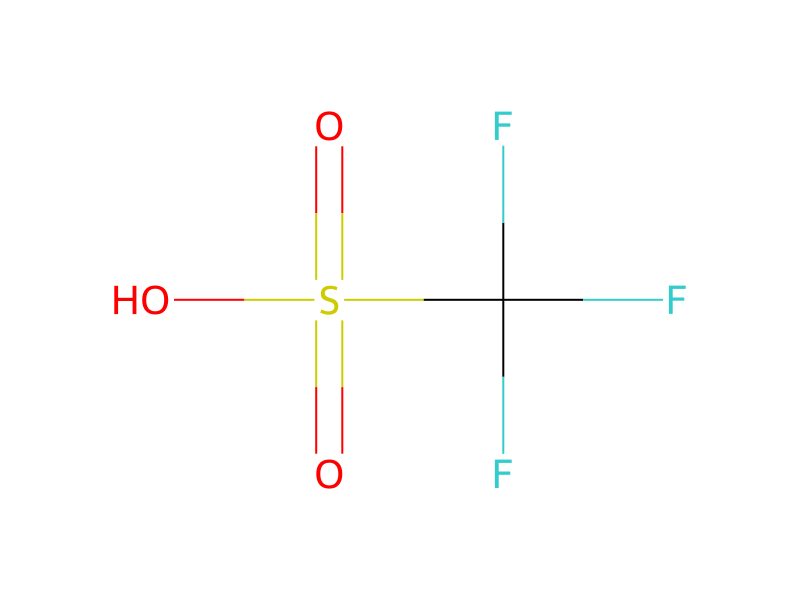

Product 1

Reagents, catalysts & solvents 2


Procedure
Pyridine (10 ml) was added slowly and dropwise to a dichloromethane (60 ml) solution of 1,7,8-trifluoro-2-naphthol (10 g) and trifluoromethanesulfonic acid anhydrate (10.3 ml) at the temperature of the ice/water, and then the reaction solution was stirred for 30 minutes. Water and dichloromethane were added slowly in the reaction solution. The organic layer was removed, and the aqueous layer was extracted with dichloromethane. The organic layers were combined, washed with water, 10% hydrochloric acid, a saturated sodium hydroxide aqueous solution, water, and brine consecutively, and concentrated. The residue was purified by column chromatography (silica gel, hexane/ethyl acetate=19/1), and 1,7,8-trifluoronaphthalene-2-yl trifluoromethanesulfonate was obtained as light yellow crystals.
Workup
- customThe organic layer was removed
- extractionthe aqueous layer was extracted with dichloromethane
- washwashed with water, 10% hydrochloric acid
- concentrationa saturated sodium hydroxide aqueous solution, water, and brine consecutively, and concentrated
- customThe residue was purified by column chromatography (silica gel, hexane/ethyl acetate=19/1)
Sources & evidence
- ORD record
- ord-ee7ad5da31a64fbcafa54725ac7d2db7
- Source dataset
- uspto-grants-2007_05
- Patent number
- US07214835B2
Reaction notes
Loading…